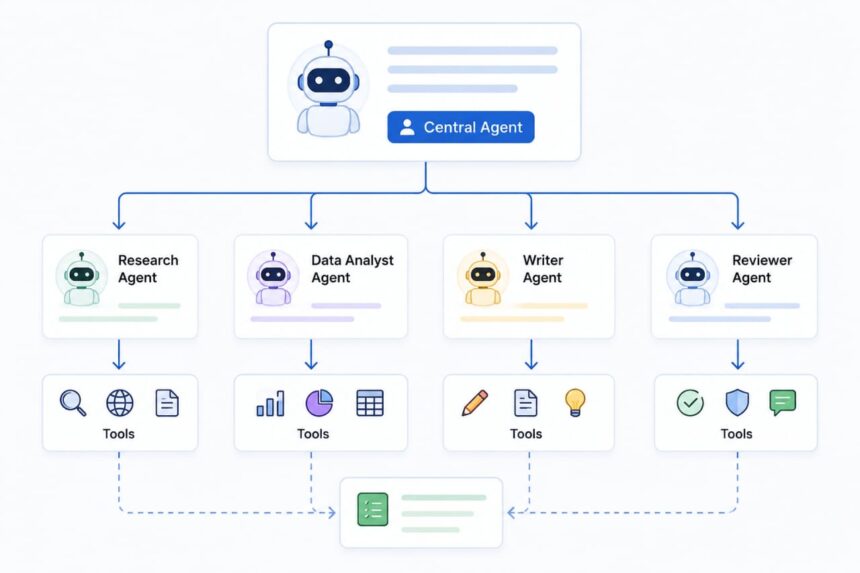
A recent empirical study looked at 1,575 LLM-based agent projects on GitHub and 8,710 related developer discussions, which tells you something important: agent development has moved well beyond toy demos. Developers are now wrestling with real orchestration problems, and nested AI agents are one of the clearest answers emerging from the field.
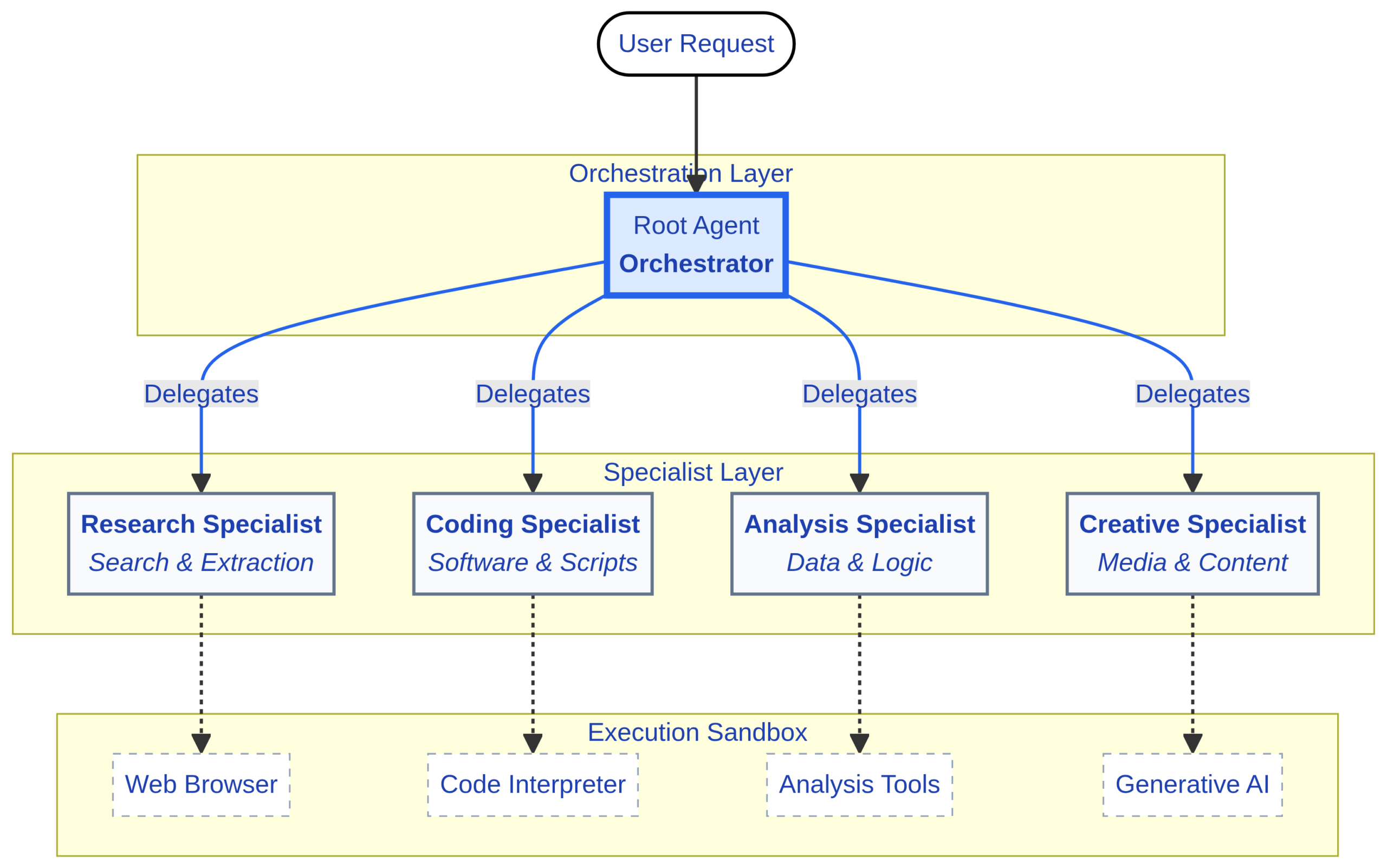
Here is the thing, instead of asking one agent to do everything, you let a root agent delegate to specialist subagents that work in parallel or in tightly scoped turns. OpenAI describes this as a model spinning up and coordinating subagents for tasks that benefit from parallel work, focused context, and model-directed coordination.
This approach changes how developers design software, debug failures, manage permissions, and think about state. Nested agents are not just “more AI.” They are a different way of structuring work.
Key takeaways
- Nested agents split one large job into smaller specialist tasks.
- They can improve speed when workstreams are independent and parallelisable.
- They also add orchestration overhead, cost, and new failure modes.
- They make context cleaner by keeping each subagent bounded.
- They demand better logging, permissions, and evaluation than a single-agent setup.
What Nested AI a Agents Are
The easiest way to think about nested agents is as a supervisor-worker system. LangChain’s multi-agent docs describe the supervisor pattern as a central agent coordinating specialised workers, each handling a different kind of expertise. That separation is useful when one agent would otherwise be forced to juggle unrelated tools and instructions at once.
Anthropic’s Claude Code docs make the same point from a different angle: subagents are built for task-specific workflows and improved context management, and they run in their own context window with their own prompt, tool access, and permissions. In other words, the child agent is not just a helper. It is a contained workspace.
That “contained workspace” idea is doing a lot of heavy lifting. It lets the main agent stay clean while the specialist handles noisy work such as research, logs, file reads, or code exploration. Claude’s docs even describe delegating research to a subagent so the main conversation does not get flooded with details you will not need later.
Why Developers are Reaching for Them
The strongest reason is parallelism. OpenAI says multi-agent setups work well when tasks can be split into independent sections, because subagents can tackle them concurrently. That means faster completion on work like codebase exploration, comparing proposals, researching sources, or generating independent test suites.
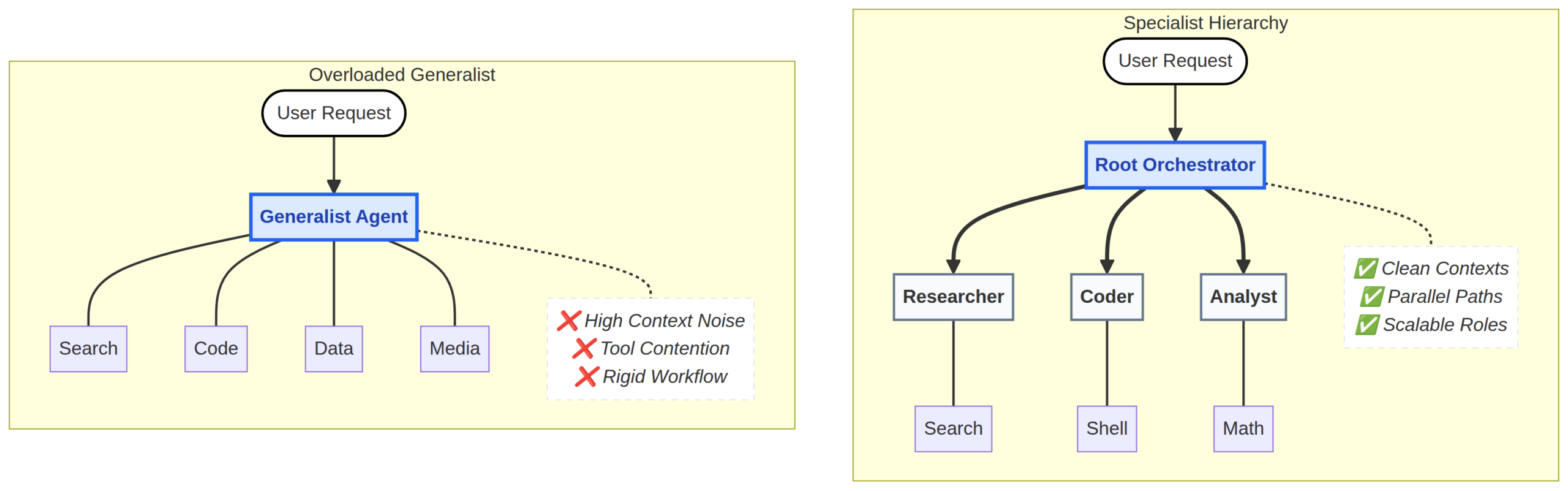
The second reason is context control. Every developer who has tried to push a single agent across a large project knows the feeling: the conversation gets noisy, tool choices get messy, and the model starts mixing concerns. Bound each child agent to one job, and the main reasoning thread gets much easier to follow. OpenAI, LangChain, and Anthropic all point to bounded or separate context as a real advantage.
There is also a practical developer ergonomics angle. Microsoft’s Agent Framework says it combines multi-agent abstractions with enterprise features like session-based state management, type safety, filters, telemetry, and graph-based workflows. That is a strong signal that nested agents are becoming a serious engineering pattern, not a research curiosity.
Where the pattern helps—and where it hurts
| Use nested agents when… | Prefer a single agent when… |
|---|---|
| Work can be split into independent, bounded tasks. | The task is small enough for one run. |
| Different specialists need different prompts or tools. | Every step depends directly on the previous step. |
| Parallel exploration would save time. | You need one deterministic execution path. |
| Security boundaries should differ by role. | All tools touch the same mutable state. |
Multi-agent orchestration becomes useful when a single agent can no longer handle the complexity reliably, but it also adds coordination overhead, latency, and failure modes. That is the part many demos skip.
Nested agents can increase token usage and are less helpful when the task requires a single ordered chain of reasoning, frequent writes to shared mutable state, or one slow external operation dominating the run. That is a good gut check for developers who are tempted to add agents everywhere just because they can.
This is where a lot of prototypes go wrong. I keep seeing teams ask one agent to research, write, review, test, and approve its own output. It feels elegant for about ten minutes. Then the context window fills up, the prompt gets messy, and nobody can tell which step broke first. Nested agents help, but only when the boundaries are real.
What Nested Agents Mean in Day-to-Day Development
For developers, the job changes from “write the smartest prompt” to “design the right boundaries.” You need to decide which agent owns which responsibility, which tools each one can touch, how they exchange results, and where human approval is required.
That means observability matters much more than it did in a simple chat flow. If a subagent picks the wrong source, you need traces. If a reviewer rejects output, you need to know which branch produced it. If a child agent fails, you need enough logging to reproduce the path.
It also means permissions have to be tighter. Claude Code’s subagent model supports custom prompts, specific tool access, and independent permissions, which is a sensible way to limit blast radius. In a nested system, every extra capability is also an extra place where things can go sideways.
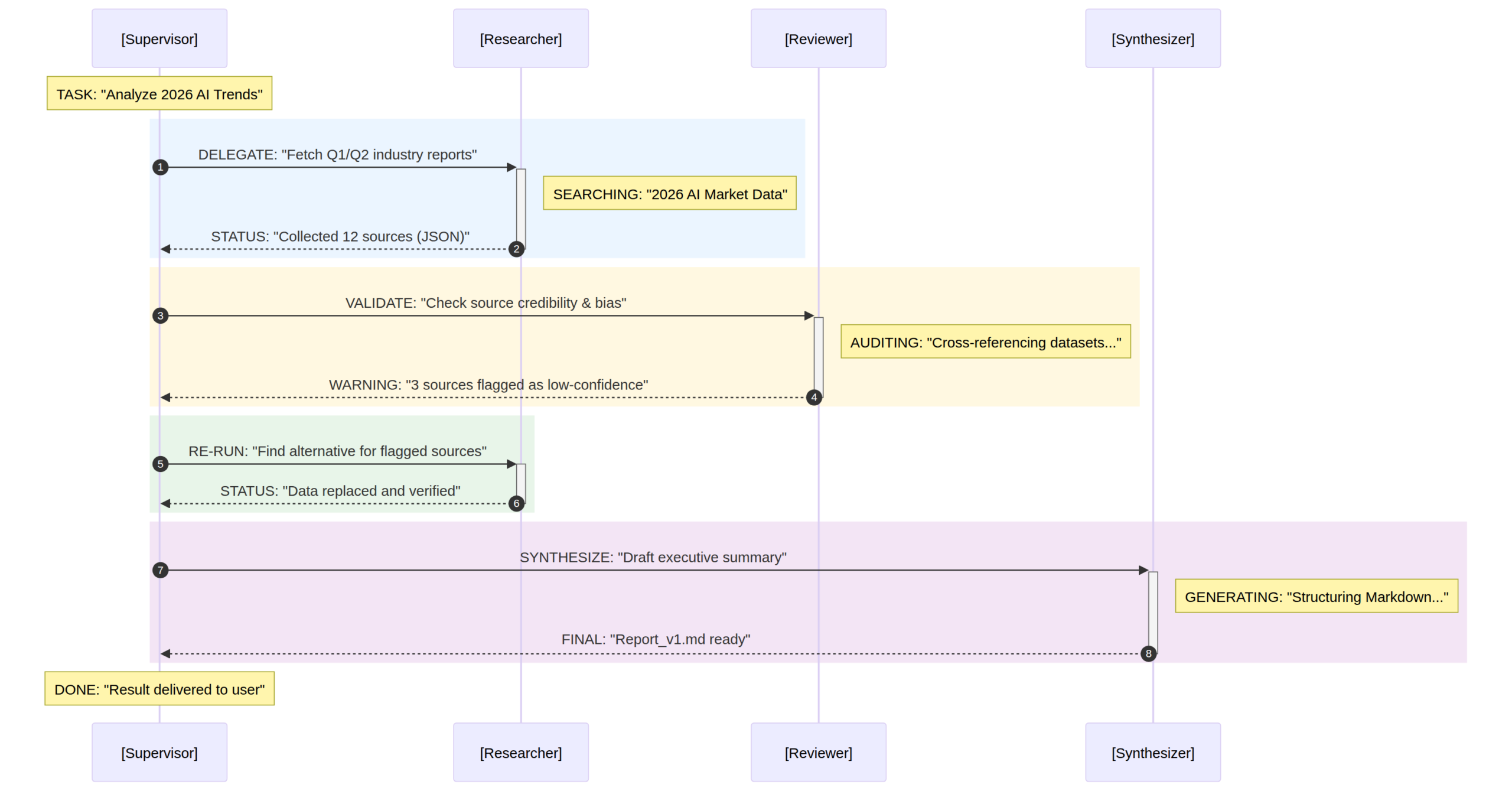
A Simple Way to Build one
- Start with one root agent that owns the final answer.
- Split the task into independent chunks, not vague “subtasks.”
- Give each subagent a narrow prompt, narrow tools, and narrow permissions.
- Let the root agent collect, compare, and synthesise the outputs.
- Add human review anywhere mistakes would be expensive or irreversible.
- Instrument everything: tool calls, handoffs, retries, and final decisions.
If you build them this way, nested agents start to look less like magic and more like good software design. LangChain’s Deep Agents and Microsoft’s graph-based workflows both point in this direction: planning, subagents, memory, and explicit orchestration are becoming the basic building blocks of serious agent systems.
Nested AI agents are not about replacing developers. They are about giving developers a cleaner architecture for work that is too broad, too noisy, or too parallel for one model to handle well.
That is the part worth paying attention to. Nested agents do not erase complexity. They organise it. And for developers, that may be the most useful trick of all.

Discover more from Aree Blog
Subscribe now to keep reading and get access to the full archive.