
Here is the big clue that this is no longer a fringe topic: NIST is now actively exploring how software and AI agents should be identified, authorised, audited, and constrained. This is a sign that the security conversation has moved beyond prompts and outputs and into the much harder question of what happens when software can act on your behalf.
That is the real reason AI agent security is breaking out as its own discipline. A chatbot answers. An agent plans, calls tools, touches APIs, reads data, writes data, and keeps going. Once software can do all that, the old security assumptions get thinner very quickly.
Microsoft has already described agentic systems as vulnerable to familiar software risks while also introducing new threat classes such as agent hijacking, intent breaking, sensitive data leakage, supply-chain compromise, and inappropriate reliance.
From Chatbots to Digital Workers
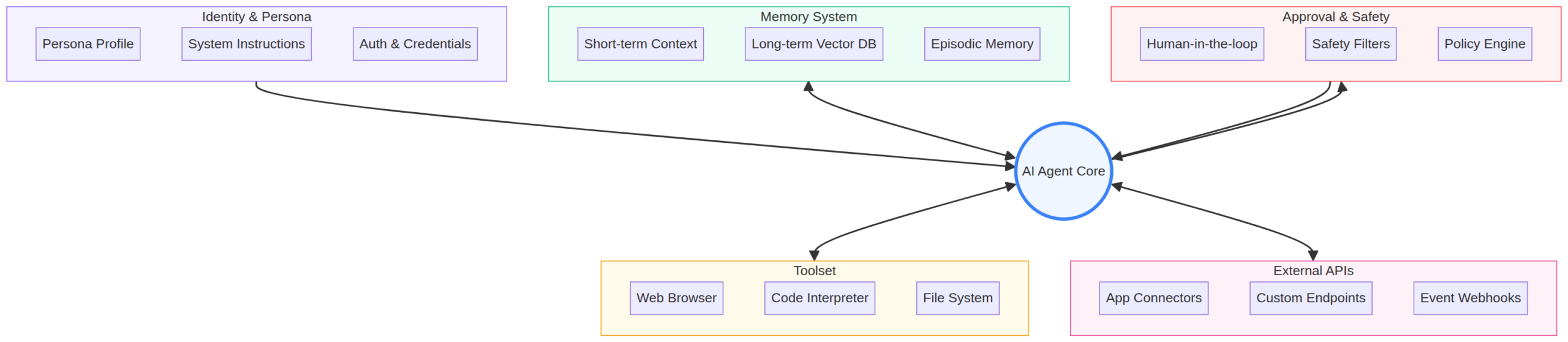
The easiest way to think about the difference is this: a chatbot is a conversation surface, but an AI agent is an action surface.
Anthropic puts it plainly in its guidance on trustworthy agents and prompt-injection defences: agents need to browse, work with context, and take actions, which means every webpage, document, or external input they touch can become a place where an attacker hides instructions.
That changes the security model. If a support agent can read customer records, draft replies, and issue refunds, the problem is no longer just “did the model answer correctly?” The question becomes, “what is this agent allowed to do, under what conditions, with which secrets, and how do we prove it later?” That is why NIST’s current work focuses so heavily on identification, authorisation, delegation, logging, and non-repudiation.
The Threat Surface is Wider than Prompt Injection
Prompt injection gets the headlines, but agent security is broader than that. OWASP’s agentic security work splits the risks across autonomous systems and the execution layers that give agents real-world impact. In practice, the threat list looks more like a full security programme than a single bug class.
- Tool abuse: an attacker tricks the agent into using a browser, shell, database, or API in a way the human never intended.
- Memory poisoning: the agent stores bad instructions or contaminated context and later repeats the mistake.
- Permission creep: the agent inherits more access than it needs because teams move too quickly from prototype to production.
- Intent hijacking: the agent is nudged away from the user’s actual goal and toward the attacker’s goal.
- Multi-agent contamination: one compromised agent can influence others when workflows are chained together.
That is why security leaders are starting to treat agents like they treat privileged services, not like harmless UI features. When an agent can touch production systems, it deserves the same discipline you would give a service account with database access and deployment permissions.
| Risk | What it looks like | Practical control |
|---|---|---|
| Prompt injection | Hidden instructions inside web pages, emails, or documents | Content isolation, tool filtering, human approval for risky actions |
| Tool abuse | Agent calls APIs or systems it should not reach | Allowlists, scoped credentials, least privilege |
| Memory poisoning | Bad context gets stored and reused later | Separate memory tiers, validation, review of persistent state |
| Agent hijacking | The agent is redirected toward the attacker’s objective | Policy checks, runtime monitoring, action approval gates |
This table is not theory. It is the shape of the work security teams are being pushed into right now, and it aligns closely with the controls NIST and major vendor guidance are already emphasising: identity, authorisation, auditing, and containment.
What good AI agent security looks like
If I were hardening an agent today, I would start with a boring but effective checklist. The boring part is a feature, not a bug. Boring usually means repeatable. Repeatable is what survives contact with production.
- Inventory every agent. You cannot secure what you cannot name, own, or revoke. NIST’s standards initiative is already centred on identity and authorisation for software agents.
- Scope permissions tightly. Give the agent only the tools, datasets, and endpoints it truly needs. Microsoft’s guidance is explicit that weak permissions are amplified when an agent is added to the system.
- Separate secrets from reasoning. Keep tokens, keys, and sensitive context away from free-form model access wherever possible.
- Add human approval for risky actions. High-impact actions such as payments, deletions, privilege changes, and external communications should not happen on autopilot.
- Log everything that matters. Good agent security needs traceability: who asked, what the agent saw, which tool it used, and what it changed.
Why This is Becoming a Separate Discipline
The strongest sign that a field is becoming its own discipline is when standards bodies, platform vendors, and open security communities all start building separate language for it. That is exactly what is happening here.
NIST has launched work on agent identity and standards. OWASP has formalised agentic risks. Microsoft is publishing defence-in-depth guidance for agentic systems. Anthropic is publishing practical mitigation advice for prompt injection in browser-based agents.
That combination is hard to ignore. It usually means the industry has outgrown the “just secure the model” era. AI agent security sits at the intersection of IAM, application security, cloud security, data governance, and runtime monitoring. In other words, it is not a side quest. It is becoming a proper discipline because the technology itself has crossed a boundary.

Discover more from Aree Blog
Subscribe now to keep reading and get access to the full archive.