

Every day, billions of AI predictions happen without users realizing it. Unlocking a phone with Face ID, translating a conversation without an internet connection, or filtering spam messages often happens entirely on the device in your hand.
That’s not just an engineering convenience, it’s increasingly a privacy decision. Google recommends on-device machine learning to reduce latency and improve privacy, while Apple has built much of its modern AI strategy around keeping personal data on-device whenever possible.
That approach comes at a time when organizations are under growing pressure to collect less personal information. Regulations such as GDPR encourage data minimization, and users are becoming more aware of where their information goes. Instead of sending sensitive data to remote servers for every prediction, many AI systems now bring the model to the data instead.
I’ve noticed that conversations around AI privacy often focus on encryption or cloud security, while the location of the computation itself gets surprisingly little attention. In reality, deciding where an AI model runs can influence security, compliance, latency, operating costs, and even user trust long before encryption becomes part of the discussion.
What Is On-Device Machine Learning?
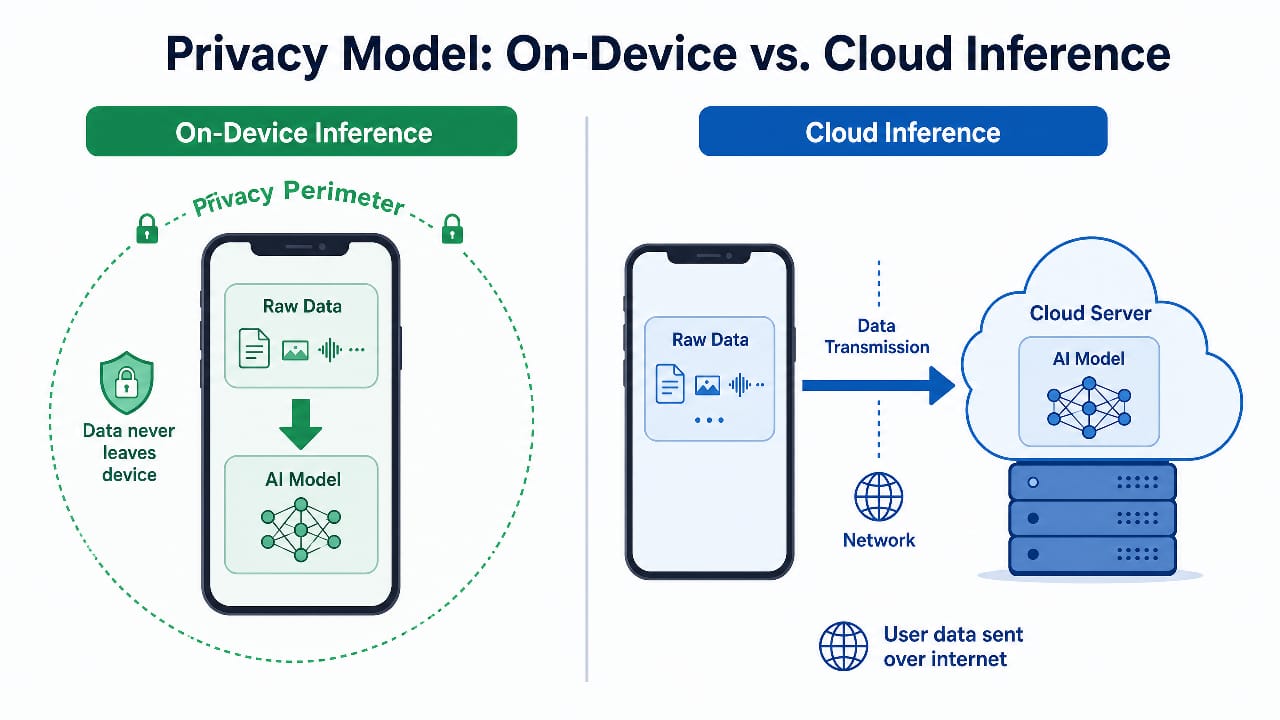
On-device machine learning (ODML) refers to running AI models directly on a phone, laptop, wearable, vehicle, industrial controller, or IoT device instead of relying entirely on cloud servers.
The concept sounds simple, but it changes how an AI system is designed. Instead of uploading voice recordings, images, or sensor readings for processing, the application performs inference locally and only sends information that is genuinely necessary.
According to Google ML Kit, local inference reduces latency, enables offline experiences, and improves privacy because sensitive data does not have to leave the device. Apple makes a similar point in its Core ML documentation, highlighting that many models can execute entirely on Apple hardware without requiring network connectivity.
Why Privacy-Critical Systems Are Moving Toward Local AI
Not every application handles sensitive information, but many do.
- Healthcare devices processing medical readings
- Financial applications analyzing transactions
- Enterprise authentication systems using biometrics
- Government applications handling citizen records
- Industrial systems monitoring proprietary operations
In each case, transmitting raw data creates another point of exposure. Even well-secured cloud infrastructure increases the number of systems involved in processing personal information.
Keeping inference local significantly reduces that exposure. It also supports data minimization principles found in privacy regulations because the application simply collects and transmits less information.
That does not mean on-device AI is automatically secure. A compromised device, poorly protected model, or vulnerable application can still leak sensitive information. Privacy starts with local processing, but it doesn’t end there.
The Building Blocks Behind Modern Private AI
Running machine learning on limited hardware requires several technologies working together.
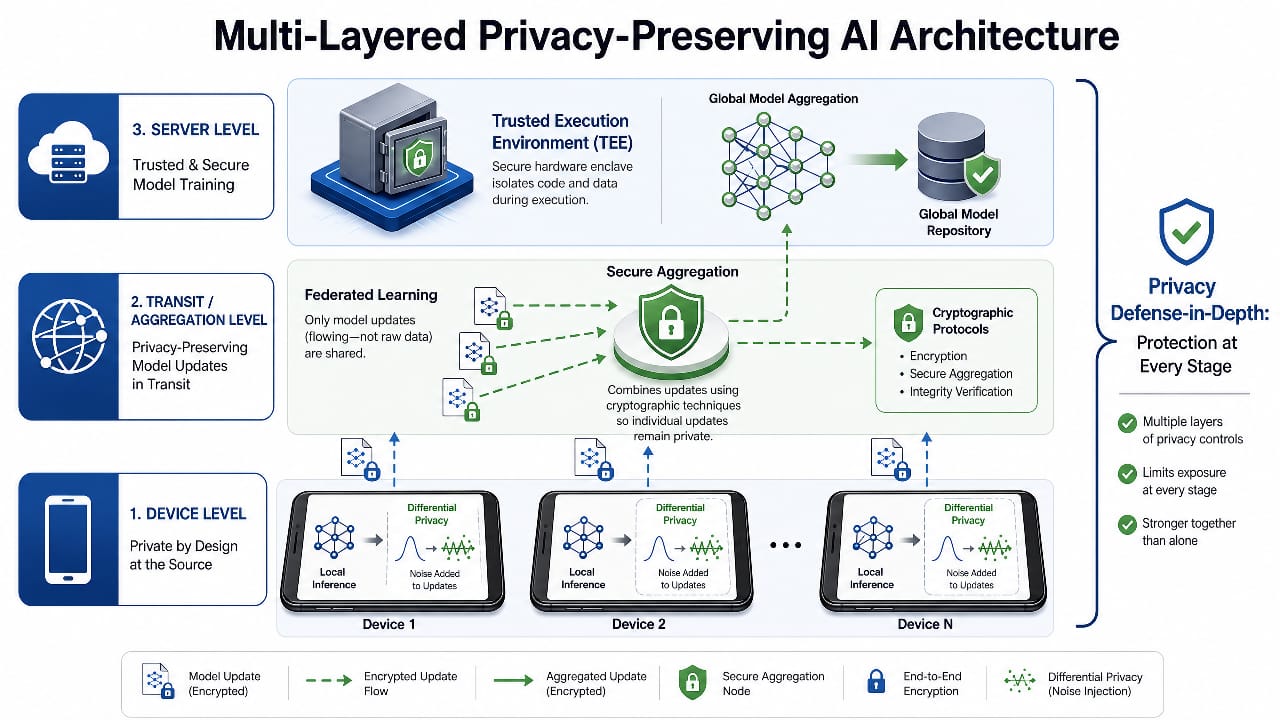
Model Compression
Large neural networks rarely fit inside smartphones or embedded devices without optimization. Developers commonly reduce model size using quantization, pruning, and knowledge distillation while attempting to preserve prediction accuracy.
Federated Learning
Instead of sending user data to a central server, each device trains locally and shares only model updates. The server combines updates from many participants to improve the global model.
Google and academic researchers have helped make federated learning one of the defining privacy-preserving techniques for distributed AI.
Differential Privacy
Even model updates can reveal information about users. Differential privacy introduces carefully controlled statistical noise that makes it significantly harder to infer whether an individual’s data participated in training. NIST has published extensive guidance explaining both its strengths and implementation challenges.
Trusted Execution Environments
Hardware isolation technologies such as ARM TrustZone and Intel SGX create protected execution environments that shield sensitive computations from the rest of the operating system.
Privacy Is Better, But New Security Risks Still Exist
One misconception deserves attention.
Moving AI onto a device removes many cloud-related risks, but it also introduces new attack surfaces.
Researchers continue to study attacks such as:
- Membership inference attacks
- Model inversion attacks
- Gradient leakage
- Model extraction
- Data poisoning
- Adversarial examples
The NIST Adversarial Machine Learning taxonomy categorizes many of these threats and highlights that securing AI requires attention throughout the model lifecycle, not just after deployment.
I often compare this to installing a stronger front door while leaving the windows unlocked. Local inference closes one important entrance, but attackers rarely stop looking after the first obstacle.
Where On-Device Machine Learning Already Excels
Many people associate on-device AI with smartphones, but adoption extends much further.
- Healthcare: Wearables detecting heart irregularities without uploading raw sensor data.
- Banking: Fraud detection and behavioral authentication with lower exposure of financial information.
- Automotive: Driver monitoring systems making millisecond decisions even without internet connectivity.
- Industrial IoT: Predictive maintenance running inside factories where cloud connectivity may be unreliable.
- Consumer Devices: Live translation, speech recognition, photo enhancement, and accessibility features.
The Trade-Off Engineers Cannot Ignore
Privacy comes with engineering compromises.
Edge devices operate under tight limits:
- Battery life
- Thermal constraints
- Limited memory
- Restricted storage
- Smaller AI accelerators
- Device fragmentation
Developers frequently spend more time optimizing models than building them. Quantization may reduce memory usage dramatically, but it can also introduce accuracy loss that needs careful testing before deployment.
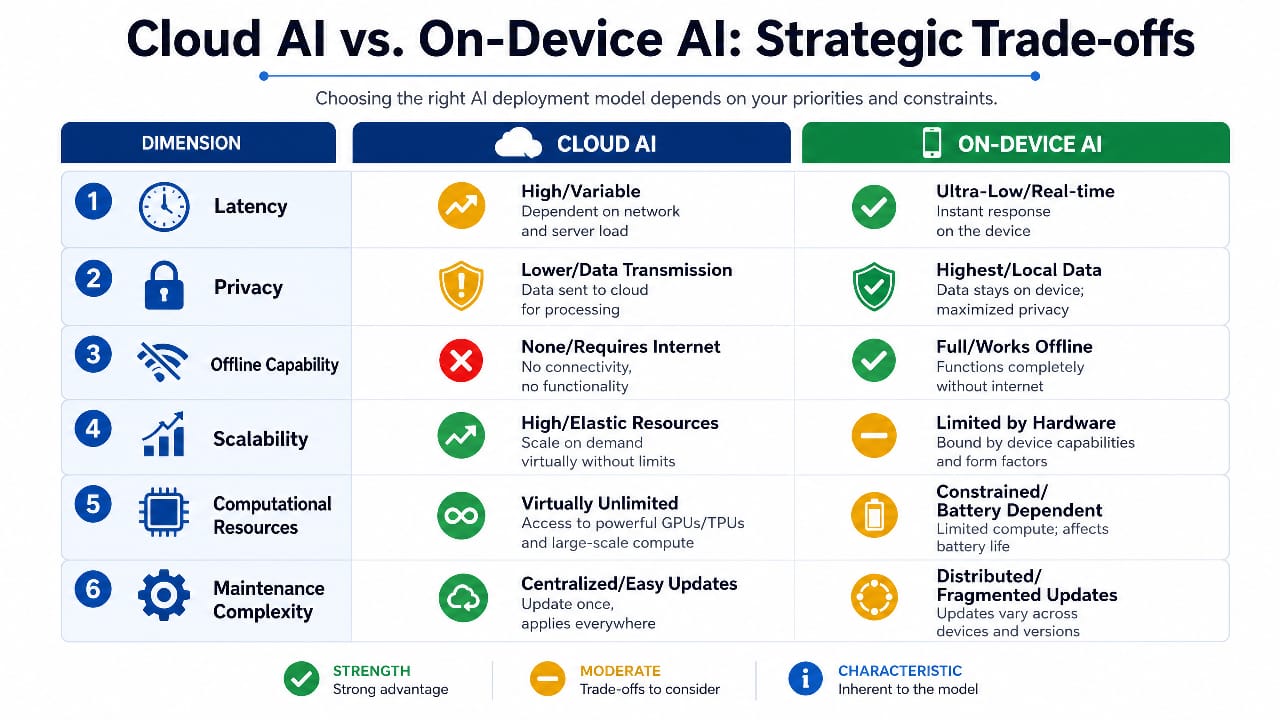
Neither approach is a universal replacement for the other. Many production AI systems use a hybrid architecture, running latency-sensitive or privacy-critical tasks on the device while relying on the cloud for large-scale processing, model training, and resource-intensive workloads.
The Future Looks Increasingly Local
Modern smartphones now include dedicated neural processing units capable of running sophisticated AI models without constant cloud assistance. At the same time, platform vendors are investing heavily in frameworks such as Core ML, ML Kit, LiteRT, and other runtimes that simplify local deployment.
Research is also moving toward privacy-preserving foundation models, federated fine-tuning, confidential computing, and secure on-device generative AI. Rather than treating privacy as an optional feature, these efforts build it into the architecture from the beginning.
A Privacy-First Future for AI
On-device machine learning is no longer a niche optimization reserved for flagship smartphones. It has become one of the strongest architectural approaches for building AI systems that respect user privacy while delivering faster, more resilient experiences.
That doesn’t eliminate the need for secure software design, robust threat modeling, or continuous monitoring. It simply starts from a better position: sensitive information remains closer to its owner. In a landscape where data exposure often begins the moment information leaves a device, that is a design choice worth taking seriously.

Discover more from Aree Blog
Subscribe now to keep reading and get access to the full archive.