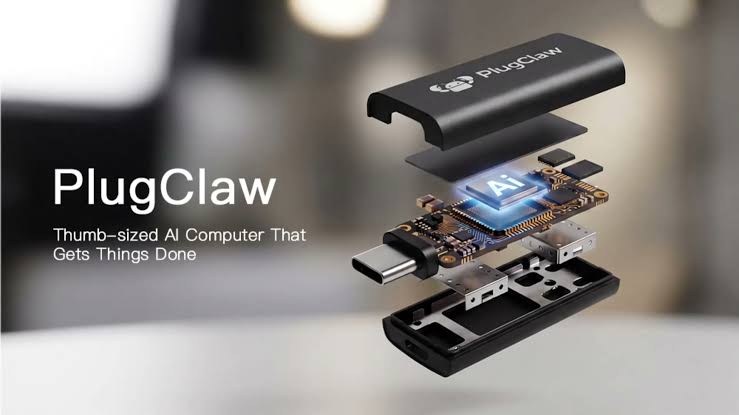
TrustKernel has begun worldwide shipments of PlugClaw, a small USB-C computer designed to give AI agents a separate computing environment from a user’s phone, tablet or PC.
The device was announced on August 12, 2026, and moved from preorder to worldwide general availability on September 4, according to TrustKernel. The company is positioning PlugClaw as a “Private AI Computer” aimed at running autonomous AI tasks without placing the agent directly inside the user’s primary device.
PlugClaw measures about 50 × 19 × 8 mm and weighs roughly 14.3 to 15 grams. It connects through USB-C and contains its own processor, memory, storage and operating systems.
The hardware uses a MediaTek Helio G80 eight-core processor and comes in configurations with 4GB or 6GB of RAM. Storage options are 64GB and 128GB, with TrustKernel describing the storage as encrypted.
The device uses USB 2.0 with a maximum theoretical transfer rate of 480 Mbps. TrustKernel lists a 5V/1A maximum power requirement and an aluminium-alloy enclosure.
PlugClaw runs PlugOS alongside Ubuntu 24.04. The Linux environment is used for the AI-agent workload, while PlugOS provides the device’s Android-based environment.
TrustKernel says the arrangement is designed to keep the agent, its credentials, applications, files and working data on the PlugClaw rather than directly on the host device. The company also says PlugClaw does not require administrator access to the connected phone or computer.
The approach is intended to reduce the agent’s access to a user’s main computing environment. TrustKernel describes the goal as limiting the potential impact of an AI agent to the separate device instead of giving that agent broad access to the host.
PlugClaw uses OpenClaw as its agent runtime. TrustKernel says it has extended the environment with Android GUI-agent capabilities and Android-Use features that allow the agent to interact with Android applications through graphical interfaces.
According to the company, those capabilities can be used for tasks such as reading and replying to messages, organizing files, browsing the web, preparing research, creating presentations, organizing meeting notes and managing to-do items.
TrustKernel’s examples focus on multi-step tasks rather than simple question-and-answer interactions. The agent can be instructed to perform a sequence of actions inside applications, including opening software, entering text, tapping interface controls and navigating screens.
PlugClaw is designed to work across several host platforms. TrustKernel lists Android phones, iPhone, iPad, Windows PCs, macOS, Linux and HarmonyOS among the supported systems.
The company’s compatibility information specifies support for iPhone 15 and later, USB-C iPads and Apple Silicon Macs starting with the M1 generation.
The device also supports multiple AI model providers rather than requiring users to rely on a single model. TrustKernel lists services and models including OpenAI’s GPT, Anthropic’s Claude, Google Gemini, DeepSeek, Grok, Qwen, Kimi, GLM and Mimo.
PlugClaw supports a Bring Your Own Key (BYOK) approach, allowing users to connect their own model or API credentials.
The device is not designed to provide the computing power needed to run the largest AI models locally. Its Helio G80 processor and 4GB or 6GB of RAM are instead used to run the operating environment, applications and agent software, with more demanding model processing handled through supported cloud services when required.
TrustKernel is also promoting confidential cloud computing as part of PlugClaw’s security architecture. The company says certain inference workloads can run inside hardware-backed Trusted Execution Environments using memory encryption and remote attestation.
TrustKernel says this design is intended to prevent both the company and the cloud provider from reading plaintext data used during those confidential inference operations. The company has also announced free confidential-model inference through servers deployed alongside the worldwide shipping launch.
PlugClaw starts at $149, according to TrustKernel. The company says there is no mandatory monthly subscription, although users can incur charges when using paid cloud AI services.
Each activated device includes at least $15 in AI credits, according to TrustKernel’s launch information.
The product is available in three listed hardware configurations: 4GB of RAM with 64GB of storage, 4GB with 128GB, and 6GB with 128GB.
The retail package includes the PlugClaw device, a U-shaped USB-C adapter, a protective case, a quick-start guide, a product key card and a warranty card.
TrustKernel says its work on PlugClaw builds on more than a decade of experience with secure operating systems, Trusted Execution Environments, confidential computing and hardware-backed security. The company says its technology is deployed across more than one billion devices worldwide, although that figure is a company claim.
The company previously developed PlugMate, a small private-computing product based on its PlugOS technology. PlugClaw extends the concept toward AI agents by giving the agent a dedicated hardware environment.
TrustKernel has also emphasized the device’s portability. Because the AI environment is stored on PlugClaw rather than tied to a particular host, the same device can be connected to different supported phones, tablets or computers while retaining its separate computing environment.
Security claims surrounding the product should still be distinguished from independently verified findings. Public information currently available documents TrustKernel’s architecture and claims, but a substantial independent security audit of shipped PlugClaw hardware was not identified in the material reviewed.
One public assessment published before the worldwide shipping announcement gave PlugClaw an overall score of 66 out of 100. The assessment rated performance at 60 and reliability at 75, while security and privacy each received 25. Those figures represent that assessment’s evaluation of the product’s publicly visible information and should not be treated as proof that the hardware itself is insecure.
PlugClaw’s launch comes as AI agents are increasingly being designed to interact directly with applications, websites and digital accounts. TrustKernel’s approach is to place those capabilities on a separate computer rather than installing the agent directly on the user’s primary device.
That makes the central proposition behind PlugClaw relatively straightforward: the AI agent gets its own computer, while the connected phone, tablet or PC serves as the interface through which the user interacts with it.

Discover more from Aree Blog
Subscribe now to keep reading and get access to the full archive.