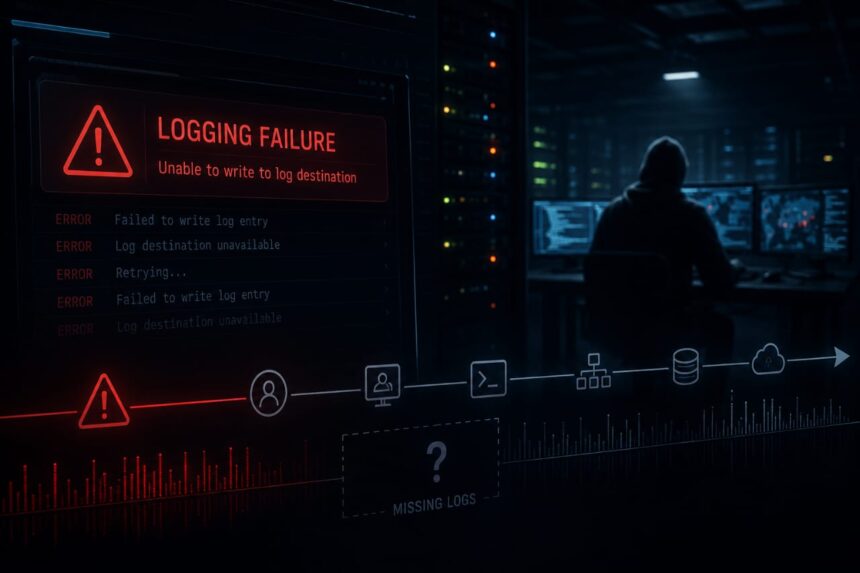
Ask a forensic investigator what separates a manageable security incident from a multi-month catastrophe, and they will point to the same thing every time: logging failures. Not zero-days. Not bespoke malware. Just the absence of adequate logs, or logs that existed but were overwritten, tampered with, or never collected in the first place.
In 2025, analysis of 160 million attack simulations revealed that organizations detect only one in seven attacks. Half of all detection rule failures traced back to problems with log collection—missed sources, misconfigured agents, forwarding pipelines that silently dropped critical telemetry. These are not edge cases. They are the norm in environments where logging is treated as an operational checkbox rather than a security control. When the logs are missing, the attacker’s dwell time stretches from hours into months, and the cost of remediation scales accordingly.
How Logging Failures Hand Attackers Their Foothold
The initial breach is rarely the problem. Attackers will find a way in—phishing, an unpatched vulnerability, a compromised credential. The problem is what happens next, and whether anyone notices. When an organization fails to log failed logins, access-control denials, or high-value transactions, it gives adversaries a silent runway to test defenses, probe for weaknesses, and establish persistence. Each unanswered attempt is intelligence. After a few days of silence, the attacker knows the coast is clear.
Once inside, sophisticated actors lean heavily on living-off-the-land techniques—using built-in tools like PowerShell, Windows Management Instrumentation, and scheduled tasks that already exist on the system. These tools are trusted, allowlisted, and used every day by IT staff. Without deep logging that captures command execution, script block content, and module loads, malicious activity looks identical to legitimate administration. The attacker is not deploying malware; they are simply using your own infrastructure against you. Nation-state groups like Volt Typhoon have maintained undetected access to U.S. critical infrastructure for years using nothing but LOTL tools, because the environments they operated in lacked the logging granularity to distinguish hostile intent from routine maintenance.
And then there is the deliberate destruction of evidence. The LockBit ransomware group’s custom builds erase Windows Event Logs as a standard operational procedure. The Volcano Demon actor clears logs before exploitation, making full forensic reconstruction impossible. The Interlock ransomware group disables endpoint detection and clears event logs before moving laterally via RDP. When logging failures are not just a gap but an active target, the defensive disadvantage compounds instantly.
What Logging Failures Cost During an Investigation
The moment a breach is discovered, the first question is always the same: “How far did they get?” Answering that question requires logs—and lots of them, stretching back weeks or months. This is where retention policy becomes a forensic weapon, for better or worse.
Advanced persistent threats routinely operate with dwell times exceeding six months. Yet many organizations retain critical security logs for 30, 60, or 90 days—windows driven by storage cost calculations rather than threat-hunting horizons. When an analyst finally spots an anomaly pointing to an initial compromise that occurred five months earlier, the breadcrumbs are gone. Overwritten by an automated rotation policy. The investigation becomes educated guesswork instead of actionable science.
Healthcare provider TTEC HS learned this lesson the hard way. In 2021, a threat actor gained privileged access through a phishing email aimed at a network administrator. For nearly five months, the attacker moved freely through the environment before triggering a ransomware event that compromised approximately 1,800 devices. When investigators arrived, they discovered that TTEC maintained active audit trail records for just 90 days. The logs were insufficient to reconstruct the attack timeline or determine the full scope of data exfiltration. The New York State Department of Financial Services imposed a $1.9 million civil penalty for failing to meet the audit trail requirements of 23 NYCRR Part 500.
The regulatory landscape leaves little room for ambiguity. PCI DSS 4.0 mandates a minimum of 12 months of audit trail retention, with the most recent three months immediately available for analysis. HIPAA requires six years of retention for logs documenting access to electronic protected health information. These are not aspirational targets. They are legal baselines, and failing to meet them carries penalties that routinely reach into the millions.
Cloud Defaults That Create Forensic Blind Spots
Cloud providers ship with conservative, cost-minded logging defaults that omit data-plane events, flow logs, and fine-grained access records. AWS CloudTrail captures management events by default—but object-level access to S3 buckets, Lambda executions, and DynamoDB item-level operations require explicit opt-in. Azure diagnostic logs for Key Vault, Storage, and SQL Database are disabled out of the box. GCP data access logs are off by default, with retention set as low as 30 days.
The consequences are predictable. When an attacker compromises a set of credentials and begins enumerating S3 buckets or downloading database backups, none of that activity appears in the default telemetry. The SOC sees nothing. The forensic team arrives later and finds nothing. The breach happened in plain sight, inside logs the cloud provider is fully capable of generating—they just were not turned on.
Building a Logging Posture That Shortens Dwell Time
Fixing logging failures is not about ingesting everything. That approach overwhelms analysts, inflates SIEM licensing costs, and produces alert fatigue that buries real signals under mountains of noise. CISA’s practitioner guidance on priority logs for SIEM ingestion explicitly warns against “logging for the sake of logging” and recommends modeling threats before selecting data sources[reference:18].
The highest-priority telemetry comes from endpoint detection and response platforms—process creation, network connections, DLL loads, scheduled task modifications, and antivirus detections. After endpoints, focus on authentication logs from identity providers like Azure AD and Okta, network device logs covering firewall ingress and egress flows, and cloud platform activity records that include data-plane events. For organizations running Kubernetes, control-plane audit logs and API server calls are non-negotiable. These log sources, when correlated properly inside a SIEM, give analysts the context needed to distinguish a routine administrative action from a lateral movement attempt.
Log integrity is equally critical. If an attacker with elevated privileges can delete or modify logs, the entire detection and forensic pipeline collapses. Immutable storage—using write-once, read-many architectures like S3 Object Lock or append-only repositories with cryptographic chaining—ensures that once an event is recorded, it cannot be altered or erased, even by insiders with administrative access. Automated integrity monitoring should watch for unexpected drops in log volume, gaps in timestamps, or modifications to logging configurations, since these are reliable signals that an active intrusion is in progress.
Retention policy must align with threat reality rather than default settings. APT investigations frequently require forensic evidence spanning six months to a year or more. A 90-day retention window is not just inadequate—it actively aids the attacker by erasing evidence before anyone knows to look for it. Mapping log sources to the MITRE ATT&CK framework helps validate which adversary techniques your telemetry can actually detect and reveals gaps before an incident exposes them.
Logging failures are not a monitoring problem. They are a visibility problem, and visibility is what determines whether a minor foothold becomes a multi-million-dollar breach. The organizations that catch intrusions early are not the ones with the most sophisticated tools. They are the ones that made the unglamorous decision to configure their logging correctly, protect its integrity, and retain it long enough to matter. That investment pays for itself the first time an analyst reconstructs an attack chain in minutes instead of admitting they will never know what happened.

Discover more from Aree Blog
Subscribe now to keep reading and get access to the full archive.