Brand protection through email authentication is one of those defensive measures that stays invisible when it works and painfully obvious when it does not. A customer sees an invoice that looks real, a supplier gets a payment change request from a familiar domain, or a staff member opens a message that appears to come from the company’s CEO. In each case, the sender name can be copied. The domain can be faked. The damage lands on the brand.
That is the real appeal of email authentication: it gives receiving mail systems a way to check whether a message is actually tied to the domain it claims to come from. The major mailbox providers are already treating that check as table stakes. Google’s Gmail sender guidelines say messages must be authenticated by SPF or DKIM, or both, to pass DMARC, while Yahoo’s sender best practices strongly urge SPF, DKIM, and DMARC for every domain that sends mail. Microsoft’s email authentication guidance makes the same point from another angle: SPF, DKIM, and DMARC work together to reduce spoofing and phishing.
That is a big change from the old “set up the mail server and move on” era. Mail is now filtered by identity, reputation, and policy. For brands, that means authentication is not just a deliverability checklist. It is part of the public face of trust.
The part attackers try to borrow is not your logo. It is your domain.
Phishers do not need to break into a company’s inbox to exploit its name. They only need a message that looks close enough to pass a hurried glance. A spoofed domain can turn a fake support notice into a believable one. A forged finance alert can look routine. A password reset email can feel urgent and harmless at the same time.
That is where the structure behind a message starts to matter. The DMARC.org overview describes DMARC as a policy and reporting protocol built on SPF and DKIM, linked to the visible “From” domain. In plain terms, it helps a receiving server answer a simple question: does this message really belong to the domain shown to the user?
DMARC is especially useful because it does not stop at a pass or fail result. It lets a domain owner tell mailbox providers what to do when authentication fails. That policy can be set to monitor only, send suspicious mail to quarantine, or reject it outright. The jump from monitoring to enforcement is where spoofing becomes harder, and where brand control becomes much sharper.
The three records that decide whether a message gets a clean bill of health
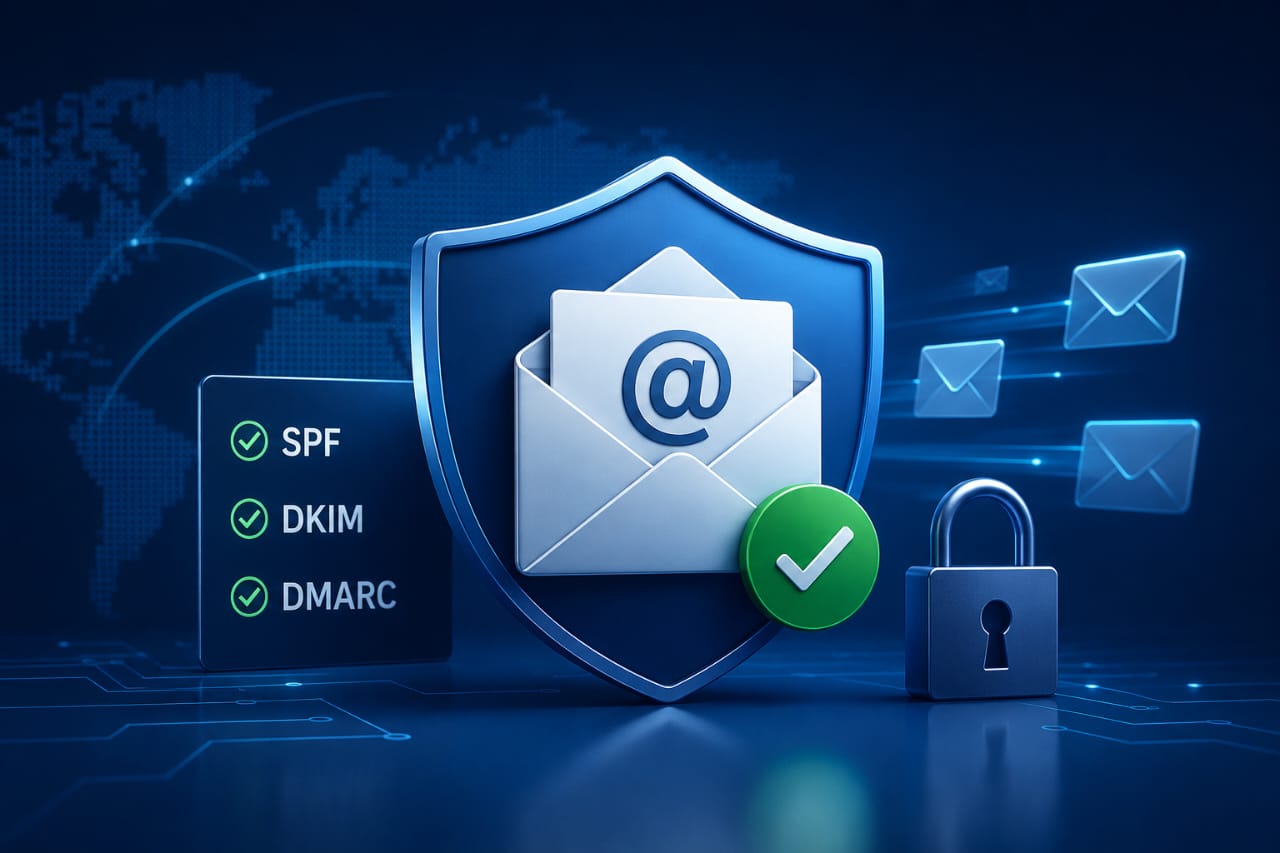
Most email authentication setups rest on three layers, each doing a different job.
- SPF: lists which servers are allowed to send mail for a domain. Microsoft’s SPF guidance recommends using a hard fail for domains that are fully protected with DKIM and DMARC, which is a useful reminder that SPF works best as part of a wider system.
- DKIM: signs outgoing messages cryptographically so the recipient can verify that the message was not altered in transit. Microsoft’s DKIM documentation is blunt about the limits here: DKIM alone does not prevent spoofing.
- DMARC: checks whether SPF or DKIM passed in a way that aligns with the visible From address, then applies the sender’s policy for failures. Google explicitly recommends full DMARC alignment with both SPF and DKIM for reliable authentication.
Those three layers do different work, and none of them is optional in a serious brand-protection setup. SPF alone can tell a receiving server that a mail host was authorized. DKIM alone can show that a message was signed. DMARC is the layer that turns those checks into a decision about the domain itself. That is the difference between basic sending hygiene and actual brand defense.
Where brands usually get caught out
The most common failure is not a lack of technology. It is partial deployment. A company may publish SPF and DKIM records, then leave DMARC in monitoring mode for months or years. That is useful for discovery, but it still leaves the brand exposed to spoofing attempts that mail providers are not instructed to block.
Another weak spot is the growing pile of third-party platforms that send mail on a brand’s behalf. CRM tools, ticketing systems, marketing automation platforms, HR tools, and payment services all need to be mapped cleanly into the authentication setup. Miss one of them, and someone will either break legitimate mail or leave a gap an attacker can exploit.
There is also the forwarding problem. Google’s sender FAQ notes that forwarded or mailing-list messages can complicate DMARC alignment, which is one reason enforcement needs care, testing, and reporting instead of guesswork.
- Multiple SPF records can create failures.
- Too many DNS lookups in SPF can break validation.
- Missing DKIM on one sending platform can create uneven results.
- DMARC left at
p=nonecan provide visibility without blocking abuse. - New SaaS tools often get added before the mail authentication map is updated.
How enforcement changes the brand story
Once DMARC moves to quarantine or reject, the conversation changes. A brand is no longer just asking mailbox providers to monitor misuse; it is telling them to act on it. That reduces the chances of a spoofed invoice reaching a customer inbox, or a fake internal memo landing inside a supplier’s mailbox with a clean appearance.
Yahoo’s guidance is useful here because it reflects how mailbox providers now think about sender legitimacy. It does not treat SPF, DKIM, and DMARC as nice extras. It treats them as the minimum posture for trustworthy sending. Gmail’s own guidance points in the same direction, and Microsoft’s documentation ties the same stack directly to protection against phishing and business email compromise.
That matters because business email compromise remains one of the most expensive forms of cybercrime. The FBI’s Internet Crime Complaint Center has reported enormous BEC losses for years, with its 2023 advisory placing global exposed losses above $50 billion over the tracked period. The point is not just that scams are common. It is that email impersonation keeps producing real financial damage, and brand names keep getting used as the delivery mechanism.
BIMI turns a hidden control into something customers can see
Once a domain is authenticated and DMARC is enforced, some brands go a step further with BIMI, short for Brand Indicators for Message Identification. The BIMI Group explains that BIMI lets supporting mailbox clients display a brand-controlled logo next to authenticated mail. The implementation guide says the domain must have SPF, DKIM, and DMARC aligned, with DMARC at enforcement, before BIMI can be used properly.
BIMI is not a security product on its own. The BIMI Group says that directly. Its value comes from sitting on top of a strong authentication foundation and making trust visible in the inbox. For a customer scanning dozens of messages a day, a verified logo is a useful cue. It does not replace caution, but it can reduce hesitation and make a legitimate message easier to spot.
The cleanest rollouts tend to follow the same pattern
Brands that handle email authentication well usually start with visibility, then move to control. They inventory every sender, publish SPF and DKIM for each legitimate service, review DMARC reports, and only then tighten policy toward quarantine and reject. That sequence keeps the business from blocking its own mail while closing the door on unauthorized senders.
For companies that depend on email for sales, support, finance, or account recovery, this is no longer a back-office task. It is part of brand management. The inbox is where trust gets tested in public, one message at a time.
And that is the real point of brand protection through email authentication: it makes the difference between a domain that can be copied and a domain that can be defended.

Discover more from Aree Blog
Subscribe now to keep reading and get access to the full archive.