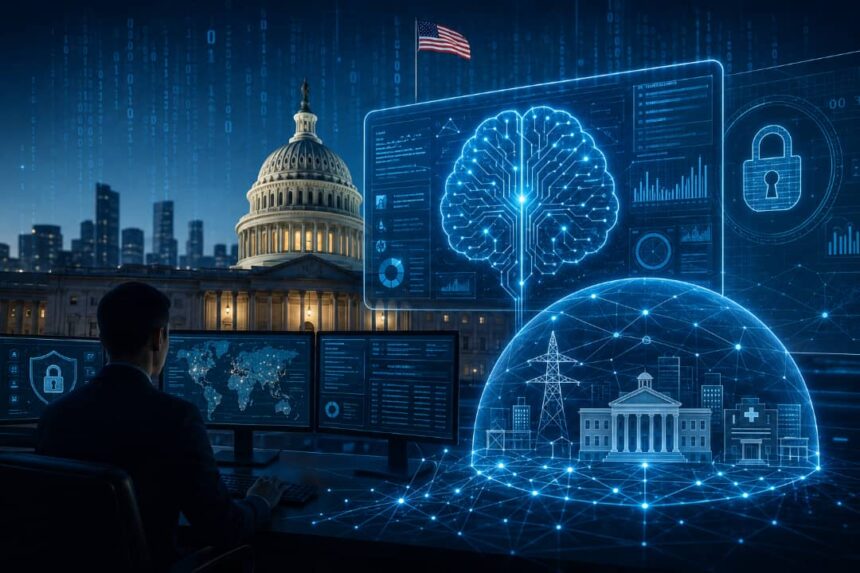
For years, governments announced artificial intelligence strategies, published cybersecurity frameworks, and launched pilot projects with ambitious goals..
This new phase of government AI cybersecurity initiatives is defined by deployment rather than planning. National security agencies, civilian departments, and regulators are introducing AI into security operations, critical infrastructure protection, software testing, fraud detection, and digital public services. The technology is also being treated as a national asset that requires protection against espionage, cyberattacks, and misuse.
That combination creates an interesting balance. Governments want AI to strengthen cybersecurity while ensuring AI systems themselves remain secure. The result is a new generation of policies built around implementation, governance, testing, and continuous monitoring rather than broad policy statements.
Governments Are Building Operational AI Instead of Publishing More Strategies
The United States provides one of the clearest examples of this transition. A recent White House executive order directs federal agencies to accelerate AI adoption across national security operations while strengthening protections for advanced AI technologies. Instead of outlining long-term aspirations, the order establishes implementation deadlines, cybersecurity requirements, and coordination across agencies.
That practical approach reflects a growing reality. Modern government networks process enormous amounts of security data every second. Human analysts remain essential, yet they cannot manually examine every authentication request, software vulnerability, phishing attempt, or network anomaly.
AI fills that gap by identifying unusual behavior in real time, ranking risks, and helping analysts investigate incidents much faster than traditional workflows.
This is already becoming part of everyday government cybersecurity rather than an experimental capability.
Security Operations Centers Are Becoming Smarter
Many government Security Operations Centers (SOCs) already rely on automation to collect alerts from firewalls, endpoint protection platforms, cloud services, and identity systems. AI extends those capabilities by connecting events that would otherwise appear unrelated.
Consider a practical scenario.
An employee signs into a government network from Abuja at 9:00 a.m. Twenty minutes later, another login appears from Eastern Europe using the same credentials. Traditional monitoring systems might flag both events independently. An AI-powered platform can correlate login history, travel patterns, device identity, privilege levels, and network behavior before assigning a risk score. If the activity resembles previous credential theft campaigns, access can be restricted automatically while analysts investigate.
This reduces response times from hours to minutes.
California’s recent partnership with Anthropic illustrates how governments are extending AI beyond cybersecurity alone. State agencies plan to use Claude for cybersecurity operations, healthcare administration, motor vehicle services, and workforce support while introducing training programs to ensure employees use AI responsibly.
Protecting AI Has Become Part of National Cybersecurity
Governments are investing just as much effort in protecting AI systems as they are in deploying them.
Advanced language models represent valuable intellectual property. They also introduce new attack surfaces that did not exist a few years ago.
Cybersecurity strategies increasingly address risks such as:
- Model theft through unauthorized access.
- Training-data poisoning designed to manipulate AI behavior.
- Prompt injection attacks that bypass safeguards.
- Unauthorized access to sensitive government datasets.
- Supply-chain compromises affecting AI software components.
These concerns explain why agencies increasingly require rigorous testing before deploying frontier AI models into sensitive environments. Organizations such as the National Institute of Standards and Technology (NIST) continue expanding guidance for AI risk management, while governments collaborate with leading AI developers to establish security evaluation procedures before new systems become widely available.
The Public Sector Is Adopting AI One Service at a Time
Large-scale implementation rarely happens all at once.
Instead, governments typically introduce AI where measurable improvements can be demonstrated before expanding adoption.
Current deployments commonly include:
- Critical Infrastructure: AI monitors energy networks, transportation systems, and public utilities for cyber threats that could disrupt essential services.
- Healthcare: Security systems identify suspicious access to patient records while reducing false alarms for hospital administrators.
- Identity Protection: AI detects unusual authentication patterns that may indicate stolen credentials or insider threats.
- Fraud Detection: Government payment systems analyze transaction behavior to identify suspicious claims before funds are released.
- Software Development: AI reviews source code, identifies vulnerabilities earlier, and assists developers with secure coding practices.
These examples illustrate that AI is becoming an operational security tool rather than a standalone technology project.
International Cooperation Is Becoming Just as Important
Cyber threats rarely stop at national borders, making international cooperation increasingly valuable.
The United Kingdom has expanded its AI adoption strategy to include cybersecurity across government services and digital infrastructure, while collaboration with Germany focuses on AI safety research and secure deployment practices. The European Union is also preparing coordinated initiatives that combine cybersecurity policy with AI governance, giving member states a common framework for managing emerging risks.
Those efforts recognize a simple reality. Attack techniques spread globally within days, and defensive capabilities often benefit from shared standards, coordinated research, and compatible security practices.
Implementation Brings New Questions Alongside New Capabilities
Deploying AI inside government networks introduces responsibilities that extend beyond technical performance.
Decision-making must remain transparent, especially when AI supports law enforcement, immigration systems, healthcare, or public services. Agencies also need clear policies governing human oversight, data retention, privacy protection, and accountability when automated recommendations influence operational decisions.
Many governments now require security assessments before deploying advanced AI systems, recognizing that vulnerabilities discovered after deployment become significantly more expensive and difficult to address.
This emphasis on governance reflects an important lesson from traditional cybersecurity. Strong technology alone does not produce secure systems. Effective implementation combines technical controls, operational processes, employee training, and continuous evaluation.
The Next Stage Will Be Measured by Results
The conversation surrounding government AI has become noticeably more practical. Budget allocations increasingly prioritize operational platforms instead of research demonstrations. Procurement contracts focus on measurable outcomes, including faster incident response, stronger protection for critical infrastructure, improved fraud detection, and better resilience against sophisticated cyberattacks.
That does not mean every implementation will succeed. Large public-sector technology projects have always faced challenges involving integration, procurement, workforce training, and legacy systems. AI introduces additional complexity because agencies must secure both traditional infrastructure and the intelligent systems operating alongside it.

Discover more from Aree Blog
Subscribe now to keep reading and get access to the full archive.