Google Ads is changing how some of its target-based bidding strategies behave starting August 17, 2026. The change affects budget-constrained campaigns using Target CPA, Target ROAS, and, for Demand Gen, Target CPC.
The detail that deserves attention is easy to miss: Google says a campaign that is Limited by budget and consistently outperforming its target may no longer keep that level of efficiency automatically. Instead, the bidding system will optimize more consistently toward the target the advertiser has entered.
That does not mean Google is raising everyone’s advertising costs overnight. It is a narrower change, but for advertisers who have been getting unusually strong results from constrained campaigns, the difference could show up in their reports.
What Google is Changing
According to Google’s official documentation, the update is designed to make target-based bidding more consistent when campaigns are constrained by budget.
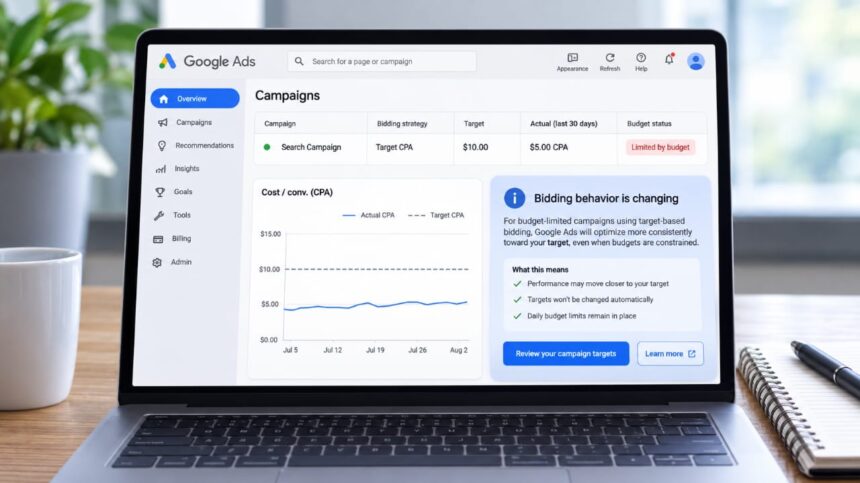
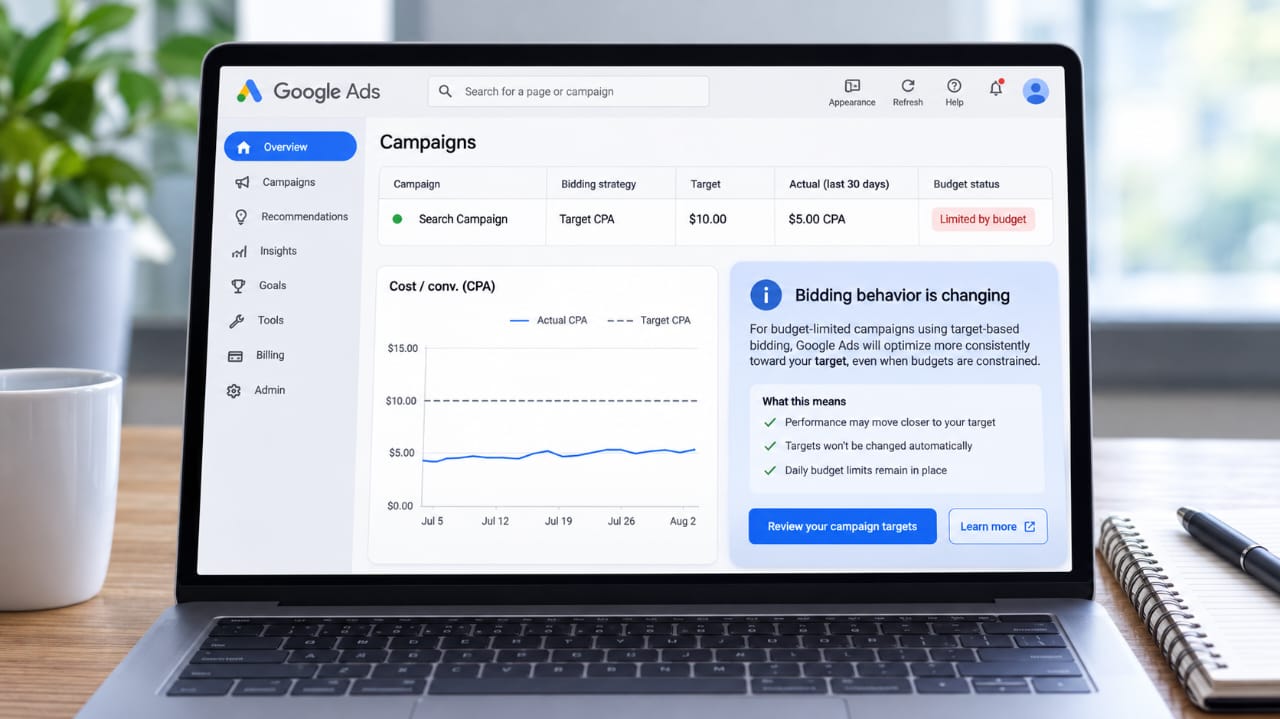
Consider a simple example. A Search campaign has a Target CPA of $10 but is producing conversions at an average CPA of $5 while its budget is limiting additional traffic. Under the new behavior, Google says that performance may move closer to the $10 target.
The advertiser’s Target CPA does not automatically change. Neither does the daily budget. What changes is how the bidding system behaves around that target.
Which Google Ads Campaigns are Affected?
The update covers eligible budget-limited campaigns using:
- Target CPA
- Target ROAS
- Target CPC for Demand Gen
Google says the affected campaign types include Search, Shopping, Performance Max, Demand Gen and Travel, with additional support in Search Ads 360 and Display & Video 360 for eligible Demand Gen setups. Google also notes that Display and Hotel campaigns already use the new behavior, while App campaigns, Video Reach campaigns and Video View campaigns continue under the previous behavior.
The distinction is important because this is not a blanket change to every Smart Bidding campaign.
Why Advertisers with “Better Than Target” Performance Should Pay Attention
This is where the update becomes more interesting.
A Target CPA is often treated as a ceiling an advertiser hopes the system can beat. But Google’s new approach makes the declared target a stronger reference point when budget is the constraint.
Imagine an ecommerce campaign with a $20 Target CPA that has settled around $11 CPA. The owner may be delighted with the $11 figure and assume that increasing the budget later will simply produce more conversions at roughly the same efficiency.
Google’s updated behavior makes that assumption less safe. If the campaign is budget-limited and consistently outperforming its target, the bidding system can pursue performance closer to the configured $20 goal.
That does not mean every campaign will land exactly on its target. Google is describing a direction in bidding behavior, not promising a fixed CPA or ROAS number.
Google has Added a Bid Target Adjustment Tool
Google began making its Bid Target Adjustment Tool available on July 6, 2026. The company says advertisers can find it through the account notification labeled “Review your campaign targets” or through the campaign’s bidding settings.
The tool is intended to help advertisers review affected campaigns and, where appropriate, adjust their targets based on recent performance. Google may suggest a revised target, but advertisers can also enter a custom value.
There is an important limitation: Google says it will not calculate a recommended target for campaigns with fewer than seven conversions, because performance from such limited data can be unpredictable.
What Advertisers Should Do Now
I would resist the urge to start changing targets blindly. The cleaner approach is to look at the campaigns that actually have exposure to the change.
- Filter for budget-limited campaigns. Start with campaigns showing a Limited by budget status.
- Check the actual CPA or ROAS. Compare recent performance with the configured target rather than relying on account-wide averages.
- Identify large gaps. A campaign with a $10 Target CPA and a recent $5 CPA deserves more attention than one already operating near $10.
- Review Google’s recommendation. Use the Bid Target Adjustment Tool instead of guessing at a new target.
- Make changes deliberately. If the existing target reflects the business goal, keeping it may be perfectly reasonable.
- Wait through the conversion cycle. Google recommends allowing roughly one to two conversion cycles before judging the result of a target change.
For advertisers who want maximum conversion volume without a target constraint, Google says Maximize Conversions or Maximize Conversion Value can be alternatives. The trade-off is that CPA or ROAS can fluctuate as budgets change.
Performance Max and Demand Gen Deserve Extra Monitoring
For multi-channel campaigns such as Performance Max and Demand Gen, Google warns that the update can also affect how traffic is distributed across channels.
That means an advertiser shouldn’t look only at headline CPA or ROAS. Watch conversion volume, conversion value, spend distribution and channel-level trends where those details are available.
Demand Gen deserves a separate note because Target CPC is included in the change there, alongside Target CPA and Target ROAS.
Google is Not Changing the Ad Auction
One point should not get lost in the noise: Google says the auction mechanism itself is not changing.
This is a bidding-behavior update. Google also says it will not automatically change an advertiser’s target or budget, and existing budget limits remain in place.
There is another temporary wrinkle. Google warns that forecasting tools may be less accurate during the transition from August 17 through August 31, 2026 while planning systems are updated for the new behavior.
The Real Takeaway for Google Ads Managers
The practical lesson is simple: your target deserves a second look if your campaign has been consistently beating it while constrained by budget.
An advertiser who genuinely wants a $10 CPA can keep that target. But an advertiser who has built a business plan around consistently achieving $5 CPA may need to decide whether $5 is actually the target that should be entered into Google Ads.
That is the subtle change here. Google is making the configured target a more important expression of what the advertiser wants from a budget-limited campaign.
For the next few weeks, I would judge these campaigns over conversion cycles rather than day-to-day noise. The campaigns most worth watching are the ones where actual performance sits materially better than the stated target.

Discover more from Aree Blog
Subscribe now to keep reading and get access to the full archive.