

Google’s Search Console now has a dedicated view for visibility inside AI Overviews and AI Mode. Microsoft’s Bing Webmaster Tools can show publishers which URLs are being cited in AI-generated answers. Cloudflare, meanwhile, is testing a system that lets website owners charge AI crawlers for accessing their content. These are not distant ideas about the future of search. They are pieces of infrastructure being deployed now.
For publishers, that creates a new problem. A piece of content can be discovered, retrieved and used to construct an answer without producing the familiar reward that came with search traffic: a human clicking through to the website.
That is the beginning of what I would call the machine audience era. People are still the audience, but they are no longer the only audience whose behavior publishers need to understand. AI systems are increasingly reading web pages, extracting facts, comparing sources and deciding which information gets represented in an answer.
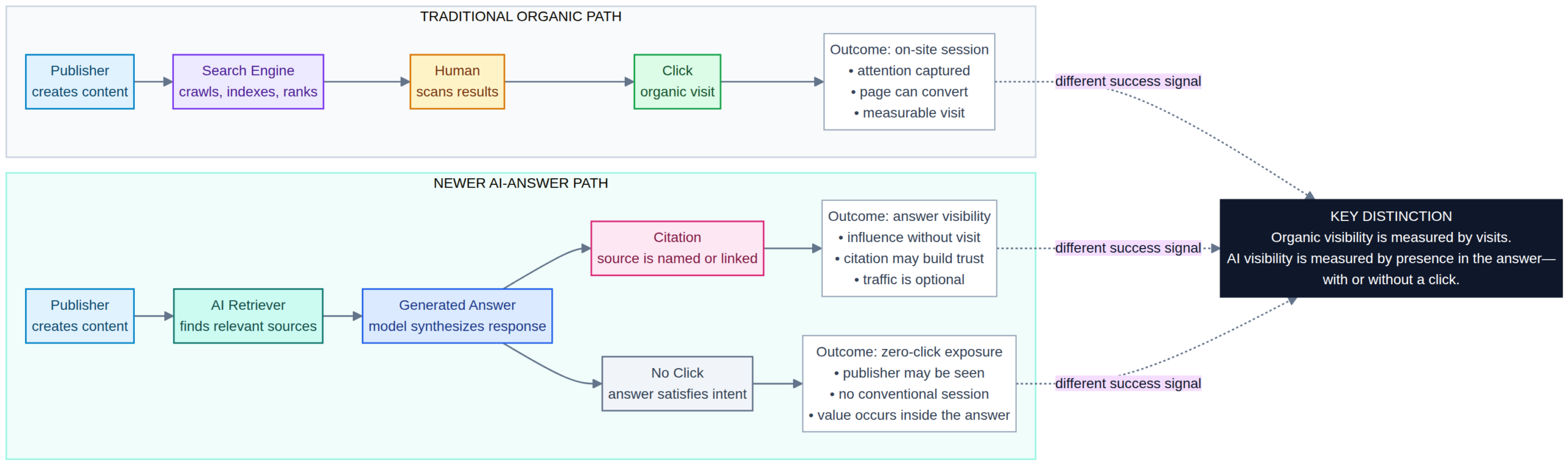
GEO Is Emerging, but SEO Has Not Disappeared
The term Generative Engine Optimization (GEO) is gaining traction because search systems increasingly generate answers rather than simply returning a list of links.
Microsoft’s Bing team has explicitly described GEO as the practice of understanding how content participates in AI-driven experiences. Its explanation is revealing: visibility is no longer limited to rankings and clicks. Content can contribute to answers, citations and the reasoning or grounding behind an AI response.
But calling GEO a replacement for SEO would be inaccurate.
Google’s current guidance says its generative search features are built on existing Search systems and that there are no special technical requirements or special markup required to appear in AI Overviews or AI Mode. Pages still need to be crawlable, indexable and eligible for normal search results.
So I see GEO less as a separate discipline and more as another layer of search visibility. The technical foundation is familiar. The measurement and the destination are changing.
The New KPI Is Not Always a Click
Bing has already started treating AI visibility as something publishers can measure separately from traditional search performance.
Its AI Performance report, launched in public preview, shows total citations, average cited pages, grounding queries and page-level citation activity across supported AI experiences, including Microsoft Copilot and AI-generated Bing summaries.
Google introduced a similar direction in June 2026 with dedicated Search Console reports for generative AI visibility. The reports provide a separate view of impressions from features such as AI Overviews and AI Mode, although Google says the rollout is initially limited to a subset of websites.
That creates a new distinction for marketers:
- Ranking visibility: where the page appears in conventional search.
- AI citation visibility: whether an AI system references the page as a source.
- AI referral traffic: whether the citation actually sends a visitor.
- Business value: whether that visitor, mention or citation produces a meaningful outcome.
Those numbers should not be collapsed into one metric. A page can be cited frequently and still receive little traffic.
Why Citation Optimization Is Becoming an Editorial Skill
There is a subtle difference between writing content that ranks and writing content that can be confidently used as evidence.
Imagine an article saying, “The company is expected to launch a new platform soon.” That sentence gives an AI system very little context. Who expects it? Based on what? When was the claim made? Which platform?
Now compare it with a sentence that identifies the company, the product, the source and the date of the underlying announcement. It gives both the reader and the retrieval system a much cleaner chain of evidence.
That is the practical side of citation optimization. It is not about stuffing keywords into an article or repeating a brand name until a chatbot notices it. It is about making claims precise, attributable and easy to verify.
Recent research is starting to examine this distinction directly. One 2026 study proposed measuring GEO in two stages: whether a system selects a source as a citation and whether the source’s information is actually absorbed into the generated answer. Using a dataset spanning ChatGPT, Google AI features and Perplexity, the researchers found that pages with strong structure and extractable evidence—including definitions, numerical facts, comparisons and procedural information—tended to have greater influence when cited. The research paper is still academic research rather than a universal ranking formula, but it offers a useful way to think about the problem.
For publishers, the editorial takeaway is simple: put the important fact where it can be understood without detective work.
Structured Data Helps Machines Understand the Page, but It Is Not a GEO Cheat Code
This is where SEO advice often gets carried away.
There is no official “AI schema” that guarantees inclusion in ChatGPT, Gemini or Google’s AI features. Google specifically says publishers do not need special structured data for AI Overviews or AI Mode.
That does not make structured data irrelevant. Quite the opposite.
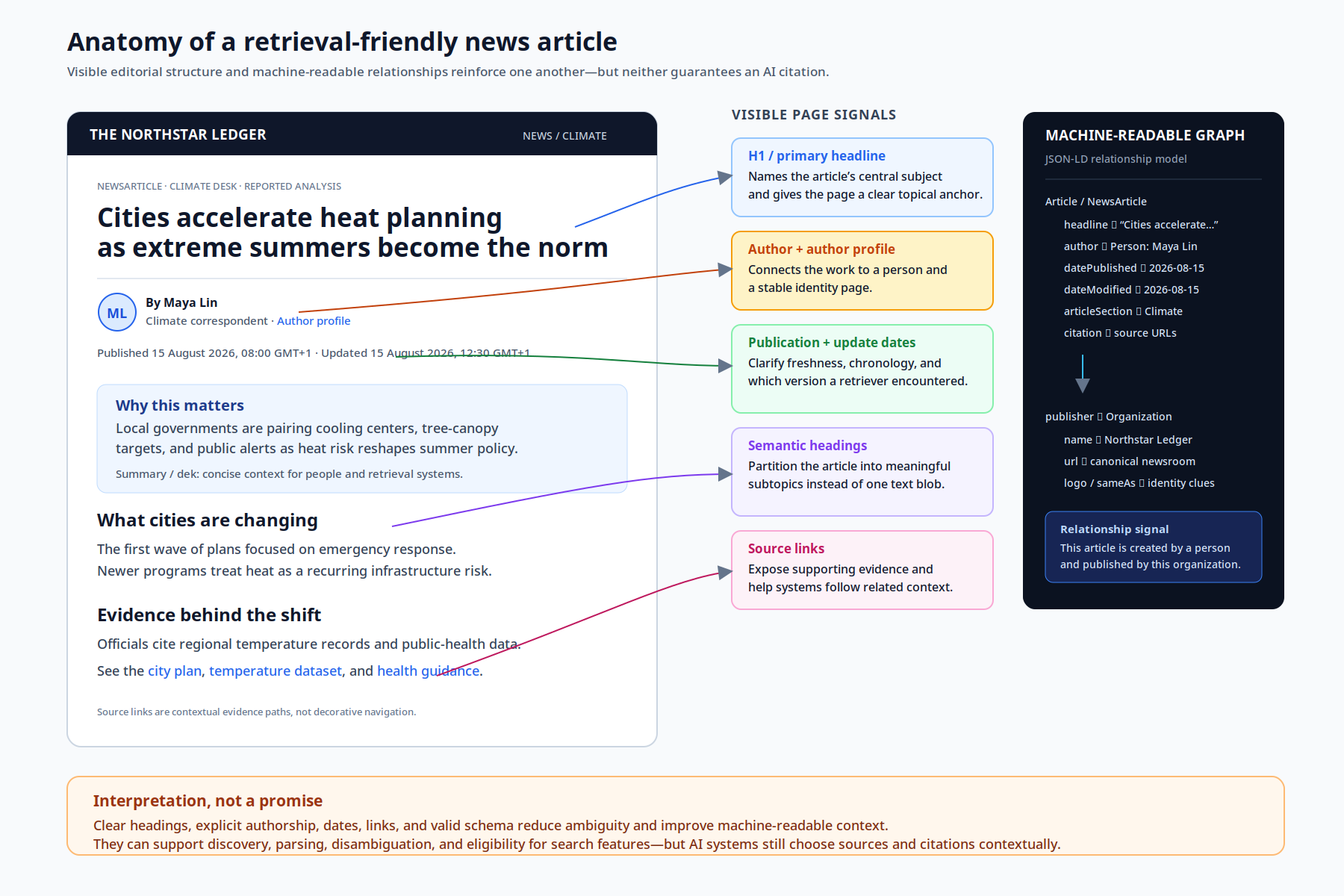
Accurate structured data can help search systems interpret entities and page types, while conventional technical SEO gives those systems a cleaner document to crawl and understand. Article, Organization, Breadcrumb, Product, Event and other relevant schema types can reinforce information already present on the page.
The important word is accurate. Google requires structured data to reflect the visible content of the page rather than describing information that readers cannot actually find.
In practical terms, a well-structured article should make it obvious who wrote it, which organization published it, when it was published, when it was updated, what the page is about and which claims are backed by primary sources.
The Traffic Problem Is Becoming Harder to Ignore
The most uncomfortable part of the machine-audience model is that being useful to an AI system does not necessarily mean receiving a visit.
A recent study using browsing data from 900 U.S. adults found that clicks to sources cited in Google AI Overviews occurred in only about 1% of AI Overview visits. The researchers also found that AI Overviews were associated with fewer clicks and more browsing sessions ending on the search page. The study has limitations like any observational dataset, but it provides a concrete warning for publishers that visibility and referral traffic can diverge.
Another 2026 study examining Wikipedia estimated that exposure to Google’s AI Overviews reduced daily traffic to English Wikipedia articles by approximately 15% in its research design. The authors found larger declines for some informational topics where a short generated answer could satisfy the search intent.
These studies should not be treated as a universal traffic forecast. Search behavior differs by query, industry and platform. But they point to a real publishing question: what happens when the answer succeeds but the source loses the visit?
AI Crawling Is Also Becoming a Cost and Access Question
There is another side to the story that is easy to overlook: AI systems do not just consume information. They consume infrastructure.
Publishers pay for hosting, bandwidth, databases, CDNs and security. When automated systems access large numbers of pages, that activity has a technical cost even when no human follows the resulting answer back to the site.
Cloudflare is experimenting with a new response: charge for machine access.
Its Pay Per Crawl system allows site owners to choose whether supported AI crawlers should be allowed, charged or blocked. The product is currently in closed beta, so this is an emerging model rather than a mature publisher revenue channel.
Cloudflare’s documentation describes a mechanism in which crawlers can receive pricing information and payment-related responses before accessing protected content. The company’s original announcement framed the idea as a third option between allowing AI crawlers to access everything for free and blocking them completely. Cloudflare’s announcement provides the technical background.
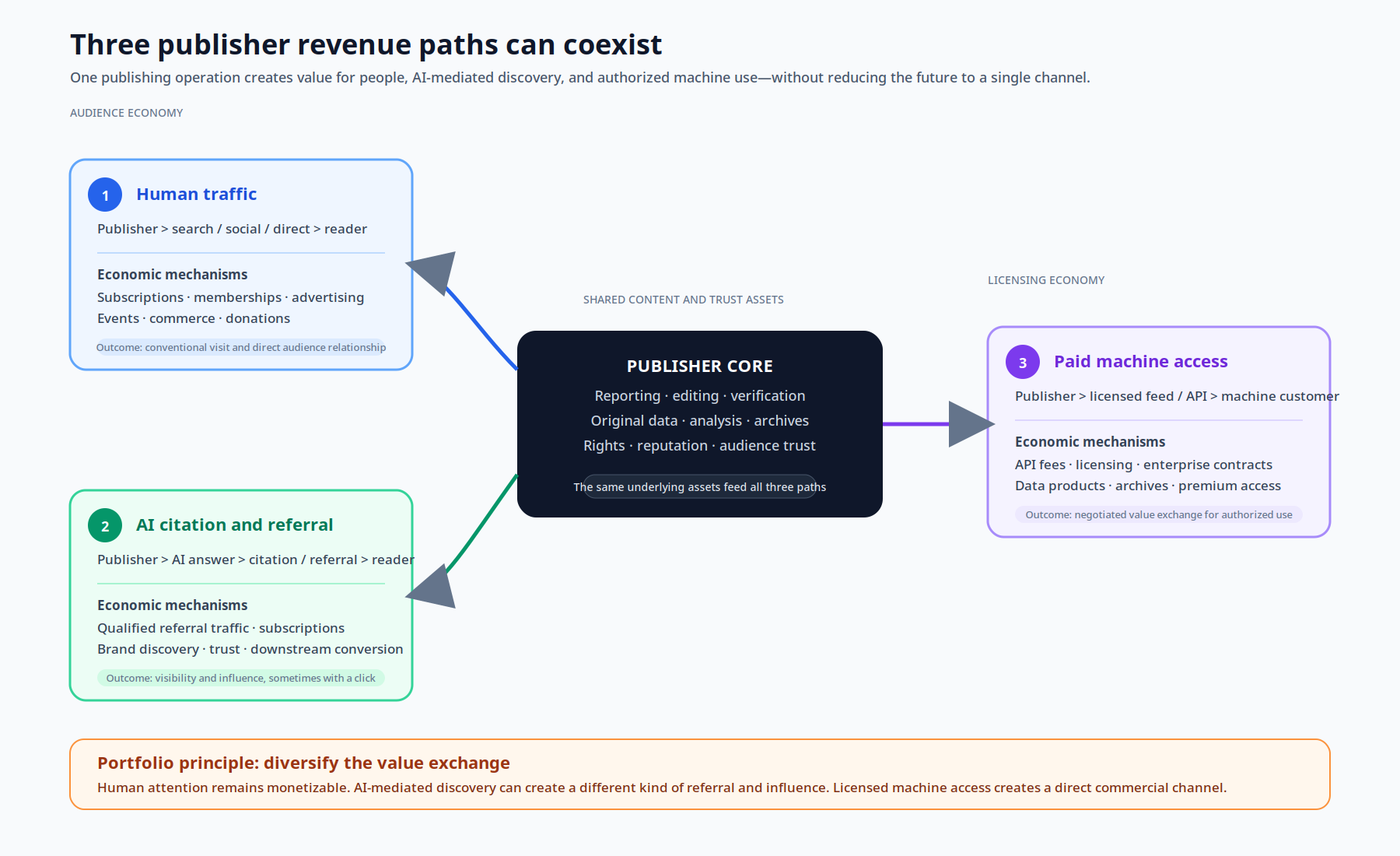
The concept is surprisingly straightforward: if an AI company benefits from automated access to valuable content, the publisher could eventually have a way to treat that access as a paid transaction rather than an invisible infrastructure expense.
Robots.txt Is Becoming Part of a Larger Machine-Access Policy
The rules are also becoming more granular.
OpenAI distinguishes between crawlers used for search and crawlers used for other purposes. Its documentation identifies OAI-SearchBot for surfacing websites in ChatGPT search and separately documents GPTBot in relation to model-training access.
Perplexity says its PerplexityBot respects robots.txt and will not index full or partial page text when a site disallows it. It also says blocked pages may still leave the domain, headline and a brief factual summary visible in its index.
For publishers, the lesson is to stop thinking about “AI crawling” as one permission switch. Search discovery, model training, retrieval and other forms of automated access can have different commercial value and different implications.
What Publishers Should Do Now
I would not rebuild a content strategy around GEO checklists. Most of the useful work is less unfamiliar.
- Keep your SEO foundation healthy. Make pages crawlable, indexable, internally linked and technically accessible.
- Make claims explicit. Name organizations, people, products, dates and numbers instead of relying on vague references.
- Put evidence next to important claims. Link directly to primary announcements, filings, studies or official documentation where appropriate.
- Use structured data accurately. Mark up what the page actually contains, rather than inventing a special AI layer.
- Write extractable answers. Headings, short explanatory sections, definitions, comparisons and clearly stated facts make content easier to understand.
- Measure AI visibility separately. Watch citations and generative-search impressions alongside conventional rankings and traffic.
- Audit AI crawler access. Know which automated systems are visiting your site and decide which forms of access you actually want to permit.
There is also a good editorial test: take your most important paragraph and imagine that an AI system can quote only two sentences from it. Would those two sentences still contain the who, what, when and evidence?
If the answer is no, the page may be harder to use than it needs to be.
The Publisher May Become Both Source and Interface
The machine-audience era does not have to end with publishers becoming passive raw material for AI systems.
There is another option: build experiences around the content yourself.
Search platforms can summarize a publisher’s reporting. A publisher can also create its own search, chatbot, recommendation layer or research assistant that keeps users inside its own information ecosystem. The strategic question becomes less about preventing every machine from seeing the content and more about deciding which machines deserve access, under what conditions, and what value the publisher receives in return.
SEO Is Becoming a Conversation Between Humans and Machines
The web was built around documents and links. Search turned those documents into a navigable information system. Generative AI is adding another layer: machines that retrieve pieces of that information and turn them into answers.
That does not make the human reader less important. It makes the publishing chain longer.
A useful article now has to survive several tests: Can a crawler reach it? Can a search engine understand it? Can an AI system retrieve the relevant passage? Can it determine what the claim actually says? Can it connect the claim to credible evidence? And, increasingly, can the publisher measure what happened after that information was used?
The best response is not to write for robots at the expense of readers. It is to produce information that is clear enough for a person, structured enough for a machine and well-sourced enough to deserve a citation.
That is the real beginning of the machine audience era. The next generation of digital marketing may be measured not only by how many people visit a website, but also by how often the web’s machines choose that website as an authority.
References for Further Reading
- Google Search Central: AI features and your website
- Google Search Central: Search Generative AI performance reports
- Bing Webmaster Tools: AI Performance
- Microsoft Bing: Grounding on the AI Web
- OpenAI: Overview of OpenAI Crawlers
- Cloudflare: Pay Per Crawl
- Perplexity: How it follows robots.txt

Discover more from Aree Blog
Subscribe now to keep reading and get access to the full archive.