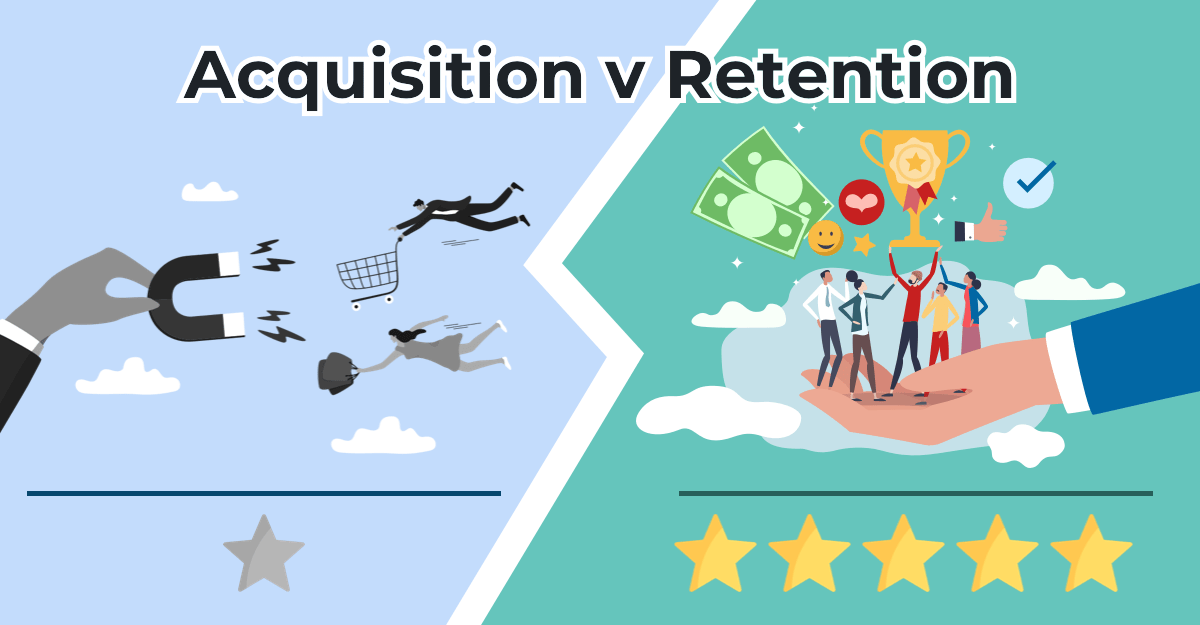
Most businesses pour the lion’s share of their budget into attracting new customers. They run ad campaigns, offer promotions, partner with influencers, and optimize their landing pages. Meanwhile, existing customers, those who already know and trust your brand, get far less attention. Yet time and again, studies show that a modest investment in customer retention delivers far higher returns than chasing new leads.
A mere 5% increase in customer retention can boost profits by 25–95%.
That statistic alone should make any marketing or business leader stop and think: Are we spending our money and energy in the right place? In this post, we’ll discuss:
- What acquisition and retention really mean
- Why retention often gets ignored
- Proven retention strategies worth investing in
- Actionable next steps to get started
By the end, you’ll understand why focusing on keeping customers engaged, satisfied, and coming back is where the real, scalable growth lies.
Acquisition vs. Retention: Definitions and Differences
Before we go into why retention matters so much, let’s define our terms.
Customer Acquisition is the process of gaining new customers or clients, your “first purchase” audience. Acquisition tactics include:
• Paid advertising (Google Ads, Facebook Ads)
• Search engine optimization (SEO)
• Content marketing and influencer partnerships
• Promotions, discounts, giveaways
Acquisition is about filling the top of your funnel with interested users and converting them into first-time buyers. It often commands a big share of your marketing budget because it’s easy to track: You spend $X on ads, you get Y new customers, you calculate cost per acquisition (CPA), and you declare success or failure.
Customer Retention is the art and science of keeping existing customers engaged, satisfied, and purchasing repeatedly over time. Retention tactics include:
• Email and SMS lifecycle campaigns
• Loyalty and rewards programs
• Personalized product recommendations
• Community building and advocacy programs
• Regular feedback loops
Retention is about maximizing the value of every customer you already have. Instead of constantly pouring money into filling the funnel, you nurture the relationships that are already in-house. You make your customers feel seen, understood, and rewarded so they stick around—and spend more with you in the long run.
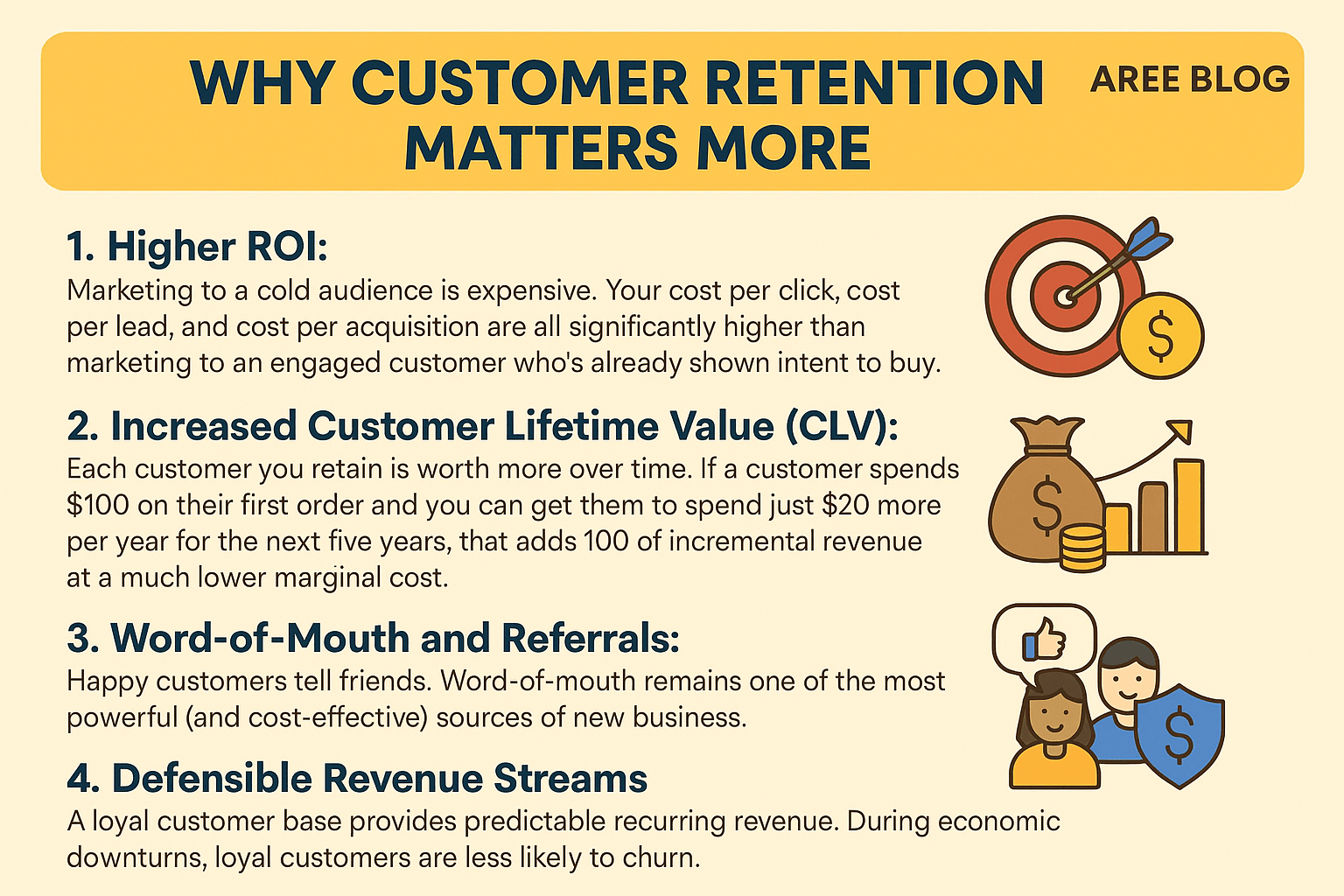
Why Customer Retention Matters More
Higher ROI: Marketing to a cold audience is expensive. Your cost per click, cost per lead, and cost per acquisition are all significantly higher than marketing to an engaged customer who’s already shown intent to buy.
Increased Customer Lifetime Value (CLV): Each customer you retain is worth more over time. If a customer spends $100 on their first order and you can get them to spend just $20 more per year for the next five years, that adds $100 of incremental revenue at a much lower marginal cost.
Word-of-Mouth and Referrals: Happy customers tell friends. Word-of-mouth remains one of the most powerful (and cost-effective) sources of new business.
Defensible Revenue Streams: A loyal customer base provides predictable recurring revenue. During economic downturns, loyal customers are less likely to churn.
Why Customer Retention Often Gets Ignored
Despite the compelling math, retention still lags behind acquisition in most marketing plans. Here are three common reasons:
1. Short-Term Metrics Bias: Marketers are under immense pressure to show immediate ROI. Acquisition campaigns can be launched, tracked, and fine-tuned daily. Clicks, sign-ups, and conversions all happen quickly. By contrast, retention unfolds over months or years. It’s harder to draw a straight line from a welcome email series to a 12-month increase in customer lifetime value.
2. Tools & Skills Gap: Retention marketing often relies on advanced data analysis, journey mapping, personalization engines, and automation platforms. Many small to mid-size teams don’t have the specialized skills or the integrated tech stack to pull it off. They might have a CRM but no marketing automation system. Or they have one-off email tools but no unified view of customer behavior across channels.
3. Creative Focus Drift: Most marketing teams “own” acquisition up through the point of conversion. After the sale, customers move to order fulfillment or customer service teams. Marketers then shift their creative and budget to the next big campaign. There’s no single owner of the post-purchase experience. As a result, engagement drops off—abandoned carts become truly abandoned, and customers forget about the initial excitement that led them to buy.
Key Customer Retention Strategies Worth Investing In
It’s clear what retention promises, but how do you get started?
Automated Lifecycle Campaigns
Automated email, SMS, or in-app messaging flows are the most important part of any modern retention program. They let you talk to customers at the right time and with the right message without having to do anything yourself.
1. Welcome Drip: As soon as someone makes their first purchase, trigger a sequence of 3–5 messages that:
- Thank them for buying
- Introduce your brand story and core values
- Share product usage tips, FAQs, or how-to videos
- Invite them to join your social channels or community
2. Post-Purchase Check-Ins: A few days or weeks after delivery, ask if they’re satisfied. Offer troubleshooting tips and cross-sell complementary items.
3. Re-Engagement Flows: If a customer hasn’t purchased in X days (30, 60, 90), trigger a sequence that might include:
- A review request (“How was the product?”)
- A special discount or incentive to come back
- Content highlighting new arrivals or best sellers
Loyalty & Community Building
A structured loyalty program or online community deepens the bond between your brand and your customers.
1. Tiered Rewards: Offer escalating perks as customers spend more or engage more often:
- Bronze: Free shipping after 3 purchases
- Silver: Early access to sales after 5 purchases
- Gold: Exclusive products or referral bonuses after 10 purchases
2. Referral Incentives: Encourage customers to bring in friends with double-sided rewards: the referrer and the referred customer both get a discount or gift.
3. Brand Ambassadors & UGC: Find your biggest fans and give them free stuff, insider perks, or swag. Then, ask them to share real content like photos, reviews, and videos. Word-of-mouth between peers is more powerful than any ad.
Personalized Customer Experience
Generic messaging feels like spam. Personalization demonstrates that you know and care about each customer as an individual.
1. Dynamic Website Content: Use browsing history or past purchases to show tailored banners, product recommendations, and pop-ups.
2. Behavioral Triggers: Send real-time SMS or push notifications:
- When a VIP customer lingers on a premium product page
- When an out-of-stock item is back in stock
- When a product they viewed goes on sale
3. Segmented Email Campaigns: Group customers by purchase history, preferences, or demographics, and send targeted offers. A wine retailer, for instance, might send white-wine lovers a special on new Chardonnay releases.
Feedback & Continuous Improvement
Retention is a nonstop process. You must learn from your customers and adapt.
1. Proactive Surveys: Right after purchase: “How was the checkout experience?”
One month in: “Are you enjoying your product?”
Quarterly: “What could we improve?”
2. Closed-Loop Follow-Up: When a customer leaves a suggestion or a complaint, follow up personally to let them know you’re taking action. Publish a “You Said, We Did” report in your newsletter to demonstrate progress.
3. Churn Analysis: Identify common patterns among customers who leave (long delivery times, poor product fit, lack of support) and attack them systematically.
Next Steps of Action
Ready to refocus some of your budget and team on retention? Here’s a simple roadmap:
1. Map Your Customer Journey: Document every touchpoint from the first ad impression to the repeat purchase. Identify gaps and quick-win moments for engagement automations.
2. Audit Your Tech Stack: Ensure your CRM, email platform, SMS tool, and analytics can share data in real time. If you’re missing an essential piece, research easy-to-integrate solutions or consider an all-in-one platform.
2. Pilot a Small Cohort: Start lean. Select 10–20% of your new buyers and run a simple 3-email welcome drip. Measure open rates, click-through rates, and second purchase rates.
3. Measure & Iterate: Key metrics to track;
- Repeat purchase rate
- Customer Lifetime Value (CLV)
- Churn rate (percentage of customers who stop buying)
- Net Promoter Score (NPS) or Customer Satisfaction (CSAT)
Review monthly. Double down on what works, refine what doesn’t, and roll out successful tests to your full customer base.
“Acquisition is vanity, retention is sanity.”
Ian Moyse, SaaS Growth Advisor
Acquisition can fill your pipeline quickly, but retention fuels predictable, exponential growth over time. By shifting some of your focus, and budget, from getting new customers to keeping and delighting existing ones, you’ll build a more resilient business, increase your profits, and turn one-time buyers into lifelong brand advocates.

Discover more from Aree Blog
Subscribe now to keep reading and get access to the full archive.