Advanced Micro Devices (AMD) has formally introduced Helios, a rack-scale AI infrastructure platform that reflects how competition in artificial intelligence is expanding beyond standalone graphics processors.
Rather than selling GPUs as individual components, the company is packaging compute, networking and software into a single integrated system designed for large-scale AI training and inference.
The launch comes as cloud providers and AI developers continue to invest heavily in infrastructure capable of supporting increasingly complex foundation models and agentic AI workloads. While Nvidia remains the dominant supplier in the market, AMD is positioning Helios as an alternative for organizations building large AI clusters.
AMD describes Helios as an open rack-scale platform built around its latest AI hardware and software ecosystem. The company says the system is now in full production and expects shipments to begin before the end of the third quarter of 2026, with broader deployments expected to ramp through late 2026 and into 2027. Reuters reported that AMD plans to begin shipping Helios by the end of Q3 after moving the platform into full production.
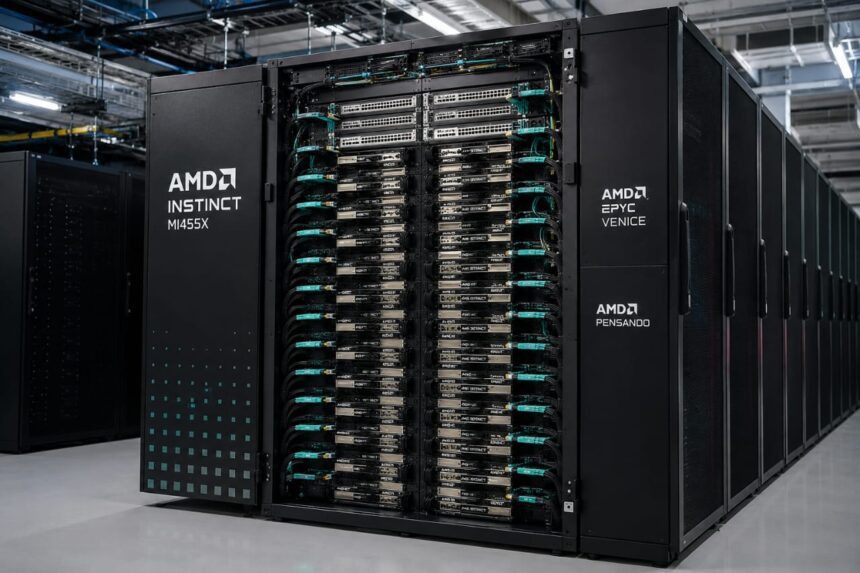
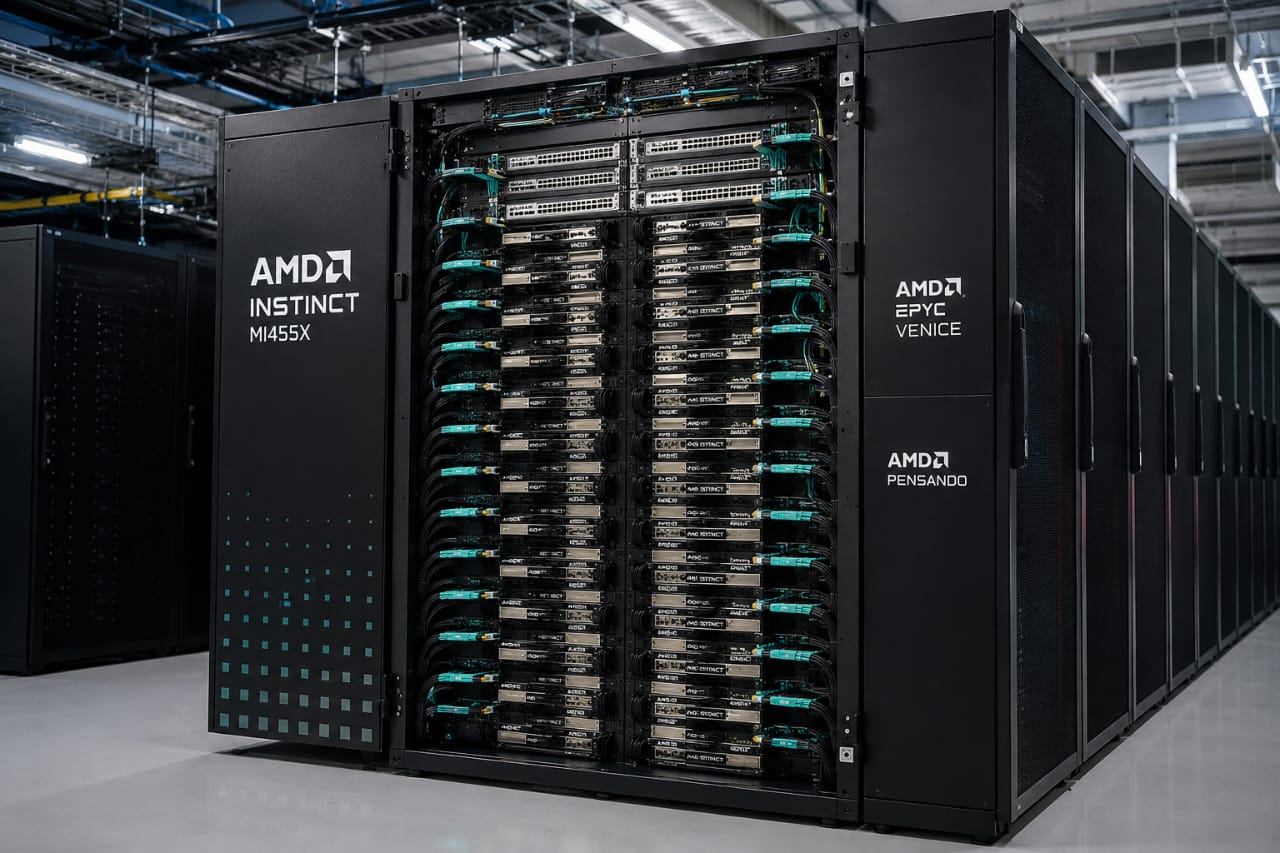
Helios is designed as an integrated rack instead of a traditional GPU server. According to AMD’s announcement, each rack combines:
- 72 AMD Instinct MI455X GPUs
- 18 sixth-generation AMD EPYC “Venice” processors
- AMD Pensando networking technology
- Ultra Accelerator Link over Ethernet (UALoE) for scale-up connectivity
- The ROCm open AI software platform
- Liquid cooling for high-density deployment
AMD says the platform provides 260 TB/s of scale-up bandwidth across the rack and is intended for both frontier AI training and large-scale inference deployments. The company has also described Helios as a blueprint for future rack-scale AI infrastructure capable of supporting trillion-parameter models.
The introduction of Helios illustrates how competition among AI chipmakers is increasingly centered on complete infrastructure rather than individual accelerators.
Modern AI deployments require tightly integrated compute, networking, memory and software, prompting vendors to package these technologies into unified systems.
Industry observers have largely viewed Helios as AMD’s response to Nvidia’s rack-scale AI offerings. TechCrunch described Helios as AMD’s attempt to challenge Nvidia in supplying infrastructure for the world’s largest AI laboratories rather than competing only on individual GPU performance.
AMD has also emphasized an open ecosystem strategy built around ROCm and open networking standards, arguing that customers want greater flexibility as AI infrastructure continues to expand.
AMD says Helios is designed to deliver up to 30% more inference tokens per dollar than competing systems, although those figures are based on the company’s own measurements and have not yet been independently verified.
The company has identified several major technology companies as early adopters or deployment partners. Reuters reported that OpenAI plans to deploy Helios servers at scale beginning later this year and continuing into 2027. Microsoft has also announced plans to bring Helios into Azure infrastructure, while Meta and Anthropic have been named among AMD’s strategic AI customers.
Recent partnerships extend beyond hardware. AMD has announced collaborations with Cerebras to create hybrid AI inference systems that combine Helios infrastructure with Cerebras compute technology for lower-latency AI workloads.
Helios also reflects AMD’s broader strategy of becoming an end-to-end AI infrastructure provider. Alongside GPUs and CPUs, the company now offers networking, rack integration and software as part of a single platform.
The direction aligns with AMD’s acquisition of ZT Systems, a company known for designing large-scale AI server infrastructure. That acquisition expanded AMD’s ability to engineer complete rack-scale systems instead of relying solely on hardware partners.
At the same time, AMD continues to grow its AI business. The company’s latest quarterly results showed data center revenue more than doubling year over year, supported by increasing demand for AI infrastructure. During its earnings update, AMD reiterated that Helios is expected to become a significant contributor as production ramps through the second half of 2026 and into 2027.
Although Helios represents AMD’s most comprehensive AI infrastructure offering to date, the company is entering a market where Nvidia has already established a strong position through its CUDA software ecosystem and existing deployments across enterprise and hyperscale customers.
Market analysts have nevertheless identified Helios as one of AMD’s most important growth opportunities. According to MarketWatch, investors are expected to closely watch Helios deployments throughout the remainder of 2026 as the platform moves from production into large-scale customer installations.
The launch highlights a broader change in the AI hardware industry. Rather than competing solely on the performance of individual accelerators, vendors are increasingly competing to deliver complete AI infrastructure that integrates processors, networking, software and system design into a unified platform. Helios places AMD squarely in that race, with the coming quarters expected to show how quickly customers adopt its rack-scale approach.

Discover more from Aree Blog
Subscribe now to keep reading and get access to the full archive.