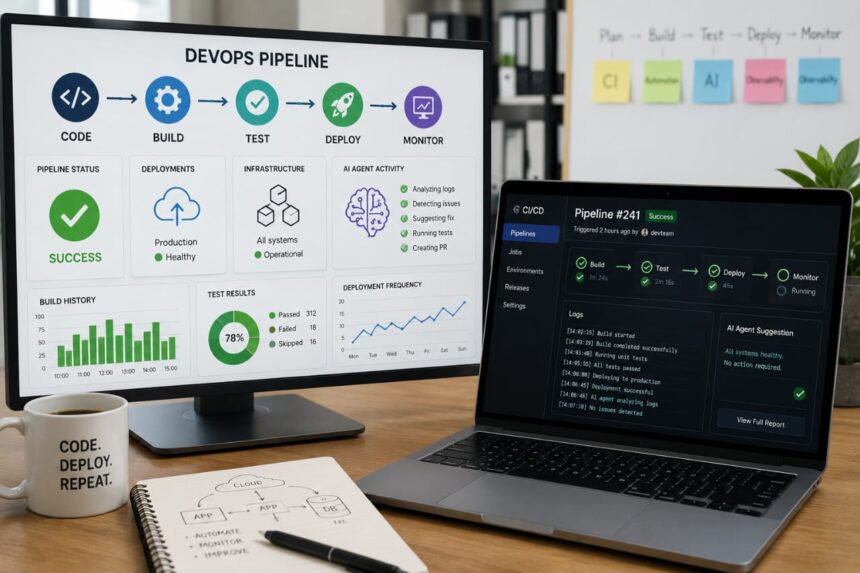
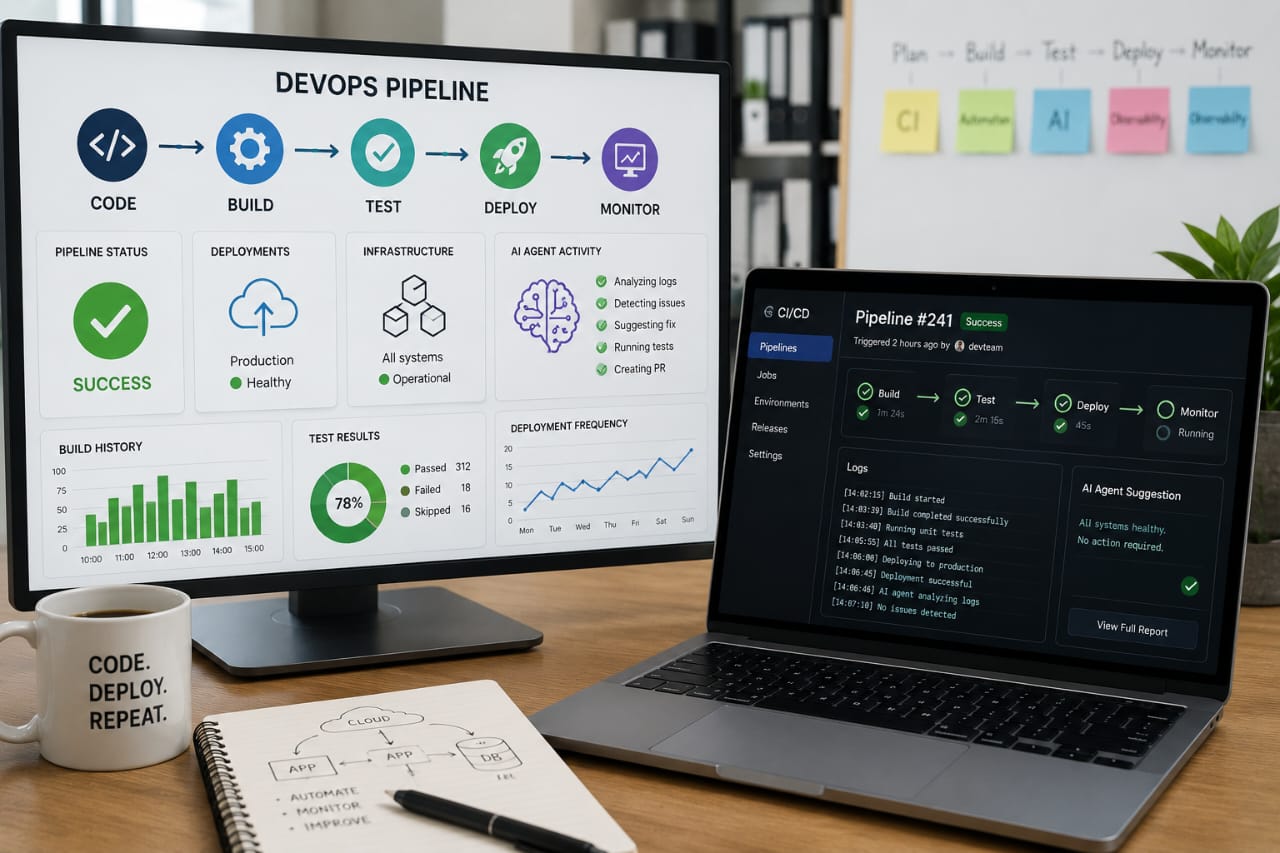
What if the next engineer to investigate your production outage isn’t a person, but an AI agent that has already collected logs, identified the root cause, suggested a fix, and prepared a pull request before your team joins the incident call?
That scenario may sound futuristic, but it is quickly becoming part of modern software delivery. The conversation around artificial intelligence in software engineering has evolved beyond code completion and chatbot assistants.
Today, organizations are experimenting with autonomous systems capable of handling multi-step operational tasks that once demanded constant human oversight. This shift is giving rise to what many now call Agentic DevOps.
Unlike traditional automation, which follows predefined scripts, agentic systems can plan, reason, make decisions within approved boundaries, and execute workflows involving multiple tools. The result is a new approach to DevOps where AI agents help developers, site reliability engineers (SREs), and platform teams deliver software more efficiently without replacing human judgment.
From Automation to Autonomous Operations
DevOps has always focused on reducing friction between development and operations through automation, continuous integration, and continuous delivery. Agentic DevOps builds on those principles by introducing AI agents that can understand objectives rather than simply execute scripts.
For example, instead of waiting for an engineer to investigate a deployment failure, an AI agent can review logs, compare recent code changes, examine infrastructure metrics, identify probable causes, and prepare a remediation plan. Google’s engineering teams are already applying agentic AI to Site Reliability Engineering to improve operational workflows while maintaining their reliability-first philosophy, according to the Google Cloud Blog.
Production Adoption Is Happening Quicker Than Expected
Many organizations still associate AI in software development with tools that generate snippets of code. In reality, enterprise adoption has progressed much further.
Recent findings from the DevOps community show AI becoming deeply embedded in engineering workflows. A CloudBees survey reported that nearly two-thirds of organizations have already integrated AI widely into software engineering processes. At the same time, 93% of IT leaders reported productivity gains, highlighting that AI has moved beyond experimentation for many development teams.
The survey also found that 81% experienced an increase in production issues linked to AI-generated code, underscoring the need for stronger governance alongside adoption.
The message is clear: organizations are embracing AI, but success depends on using it responsibly.
Where Agentic DevOps Delivers Immediate Value
The most practical implementations are not replacing engineering teams. Instead, they remove repetitive operational work.
AI agents are increasingly helping teams:
- Investigate production incidents.
- Generate deployment reports.
- Review pull requests before human approval.
- Monitor infrastructure health.
- Update documentation automatically.
- Recommend deployment rollbacks.
- Assist with infrastructure-as-code changes.
- Summarize postmortems and create follow-up tasks.
These activities allow engineers to spend less time gathering information and more time solving complex problems.
Infrastructure Is Becoming the Real Challenge
Ironically, the biggest obstacle to Agentic DevOps is no longer the AI models themselves.
Google Cloud’s 2026 infrastructure study found that 83% of organizations believe they must modernize their infrastructure before they can fully benefit from production-grade agentic AI. Legacy systems, fragmented data, governance concerns, and operational complexity remain major barriers to scaling these technologies. The report also notes that security and governance continue to rank among the most significant concerns for enterprise adoption. 2
Organizations that invested in cloud-native architectures, observability, and platform engineering are generally better positioned to adopt autonomous workflows than those still relying on disconnected legacy systems.
Governance Matters More Than Speed
As AI agents gain greater operational authority, governance becomes increasingly important.
An autonomous system capable of modifying infrastructure or deploying applications must operate within carefully defined guardrails. Human approval remains essential for high-risk actions, especially when production systems, customer data, or security configurations are involved.
This reflects a broader lesson from Google’s DevOps Research and Assessment (DORA) findings: AI performs best when paired with mature engineering practices rather than replacing them. Organizations with strong internal platforms, well-defined workflows, and disciplined software delivery processes tend to realize the greatest benefits from AI adoption.
Not Every Company Is Ready
Despite growing enthusiasm, many businesses are still struggling to move AI initiatives beyond pilot programs.
A recent collaboration between Google Cloud and Accenture highlighted that although 73% of mid-market organizations have deployed AI solutions, roughly 90% of those initiatives remain stuck in pilot stages because of governance challenges, limited expertise, and resource constraints.
This gap illustrates an important reality: implementing Agentic DevOps is as much an organizational challenge as it is a technological one.
What Comes Next?
Over the next few years, AI agents are likely to become regular members of engineering teams—not as replacements for developers or SREs, but as collaborators capable of handling repetitive, data-intensive operational work.
Developers will continue writing software, designing architectures, and making critical business decisions. AI agents will increasingly handle investigations, documentation, monitoring, testing, deployment validation, and other routine activities that consume valuable engineering time.
The organizations that benefit most will not necessarily be those using the most AI. They will be the ones combining autonomous systems with disciplined DevOps practices, reliable infrastructure, strong governance, and human oversight.
Final Thoughts
Agentic DevOps is no longer a concept confined to research labs or conference presentations. It is steadily finding its way into production environments, where AI agents are assisting with software delivery, infrastructure management, and operational reliability.
However, moving faster does not eliminate the need for caution. The future belongs to organizations that embrace AI without abandoning engineering discipline. Companies that establish clear guardrails, modernize their infrastructure, and empower engineers to work alongside intelligent agents will be far better positioned than those treating AI as either a silver bullet or something to avoid entirely.
In many ways, the question is no longer whether Agentic DevOps will become part of mainstream software delivery. The more pressing question is whether engineering teams are preparing for a future that is already beginning to arrive.

Discover more from Aree Blog
Subscribe now to keep reading and get access to the full archive.