

Travel planning just got more conversational. Google Flight Deals lets you describe the kind of trip you want in natural language, such as “long weekend with great food, nonstop only,” and returns flight options that fit your preferences. Rather than relying only on fixed destinations and dates, it uses AI to interpret your request and searches current Google Flights data for suitable fares.
Flight Deals launched in beta in the United States, Canada, and India in August 2025. It later expanded to more than 200 countries and territories, including the United Kingdom, with support for more than 60 languages. You can access it through the dedicated Flight Deals page or from the Google Flights menu.
If you’re flexible about where and when you go but rigid about budget or travel style, Flight Deals can surface options you might never have searched for manually. It is built for discovery as much as price comparison.
Key takeaways
- Flight Deals lets you describe trips in plain language and returns matching flight opportunities.
- It launched in beta in the U.S., Canada, and India before expanding to more than 200 countries and territories.
- Google searches inventory from more than 300 airlines, online travel agencies, and other travel partners.
- Savings Deals receive a “% less than usual” badge when the fare is at least 20% below Google’s typical price for a similar trip.
- Google Flights also has a basic-economy exclusion option for eligible searches, while its broader flight search includes tools for comparing baggage costs and other fare details.
What Flight Deals is
Flight Deals is essentially an AI-driven trip finder built into Google Flights. Instead of forcing you to enter a destination and fixed dates first, you can describe the trip you want, including its length, interests, preferred dates, budget, or nonstop preference. The system interprets the request and searches Google Flights inventory from more than 300 travel partners for matching options.
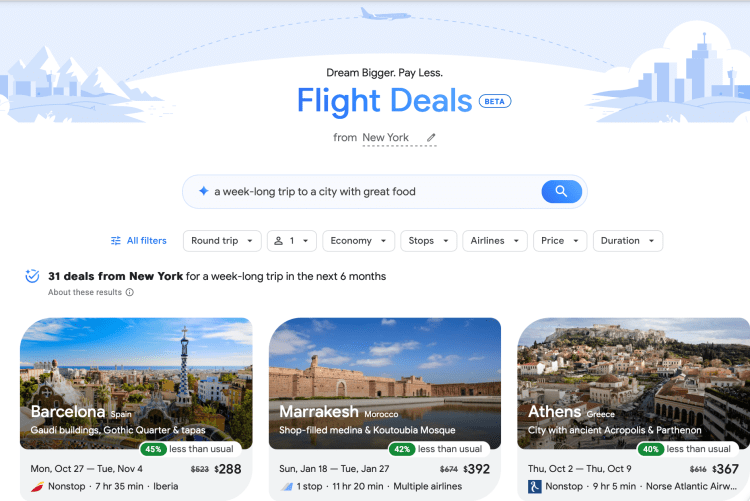
It’s not a replacement for the full Google Flights interface. Think of it as a discovery layer: use it when you know what kind of trip you want, even if you have not settled on a destination or exact dates. For some searches, including multi-city trips, groups larger than four people, and specific layover requests, Flight Deals may not return results because those searches are not currently supported.
How it Works in Practice
You might type: “five-day city break this November with excellent food and nonstop flights, budget $400.” Flight Deals interprets those preferences and searches available destinations and dates for matching fares. The system uses current Google Flights pricing and availability, so the options can change as airline and booking-partner prices change. Google says Flight Deals searches inventory from more than 300 partners.
Google also separates its deals into different categories. A “Savings Deal” is a fare at least 20% lower than the typical price for a similar trip. That typical price is calculated using historical fares, including factors such as the route, time of year, trip length, and cabin class. Google also shows some of the cheapest available flights even when they are not significantly below their usual price.
Because the inputs are flexible by design, the tool can surface destinations or dates you may not have considered. But broader prompts can also produce results that do not perfectly match what you had in mind. Google acknowledges that suggested destinations and dates may not always be a perfect match because the feature remains experimental.
Who Should Use Flight Deals, and When to be Cautious
If you’re flexible on destination or dates and your primary goal is finding lower fares or new travel ideas, Flight Deals can save time. It replaces some of the repetitive process of changing dates, destinations, and filters with a single conversational search. If you need exact dates, multi-city routing, specific passenger types, or a larger group booking, the standard Google Flights interface is still the better option. Google currently says Flight Deals does not support groups larger than four people or certain multi-city and layover searches.

The cheapest option may also come with restrictions. Google Flights provides tools that let travelers compare baggage costs, while fare details and booking conditions can vary between airlines and online travel agencies.
Competition, Regulation, and UX
Google’s move to layer AI over flight search follows its broader push toward conversational search and travel planning. The newer approach lets travelers describe an outcome rather than build every search parameter manually. The wider travel-search market still raises questions about how users discover and compare offers when a major search platform also controls the interface through which those options are presented.
For travelers, the practical question is simpler: does AI make it easier to find a useful fare without hiding important trade-offs? Google says travel partners do not pay to appear in Google Flights results, and their relationships with Google do not determine the order of offers. Still, Google notes that its results may not include every available flight or offer because airlines and booking providers must participate in Google Flights.
How to Get the Most from Flight Deals
- Be specific but flexible. Try “3–5 day beach trip in March, under $450, nonstop preferred.” Specific constraints help the AI; flexibility can open up more options.
- Compare the fare with baggage costs and restrictions. The lowest headline price is not always the lowest total cost.
- Try exploratory prompts for inspiration: “surfing weekend in May under $300.” You might find destinations you had not considered.
- Verify fare rules and baggage on the booking page before paying. Google usually sends you to the airline or booking partner to complete the purchase.
- Check the “% less than usual” badge carefully. Google uses historical prices for similar trips to calculate the comparison, while prices and availability can change before you book.
Flight Deals simplifies the creative part of planning: turning a loose trip idea into concrete flight options. Its biggest strength is flexibility, particularly for travelers who care about price and are open to different destinations or dates.
It is still an experimental feature, though, and some searches are not supported. Before booking, check the final fare, baggage allowance, and booking conditions.
Google is also extending its flight tools beyond the dedicated Flights experience. In August 2026, the company announced that flight-price tracking had been brought directly into AI Mode in Google Search, allowing users to set price alerts while discussing a trip. Google said those results can use current prices from more than 300 partner airlines and travel sites.
References for Further Reading
- Google blog: Flight Deals is our new, AI-powered flight search tool.
- The Verge: coverage and examples of Flight Deals in early tests.
- Lifewire: practical explanation of how Flight Deals interprets natural language.
- TechCrunch: context on antitrust and competition concerns.

Discover more from Aree Blog
Subscribe now to keep reading and get access to the full archive.