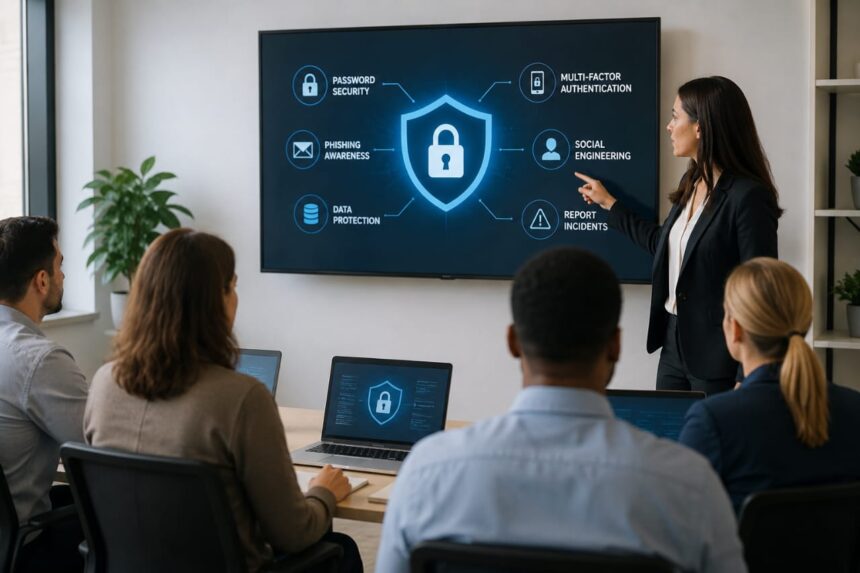
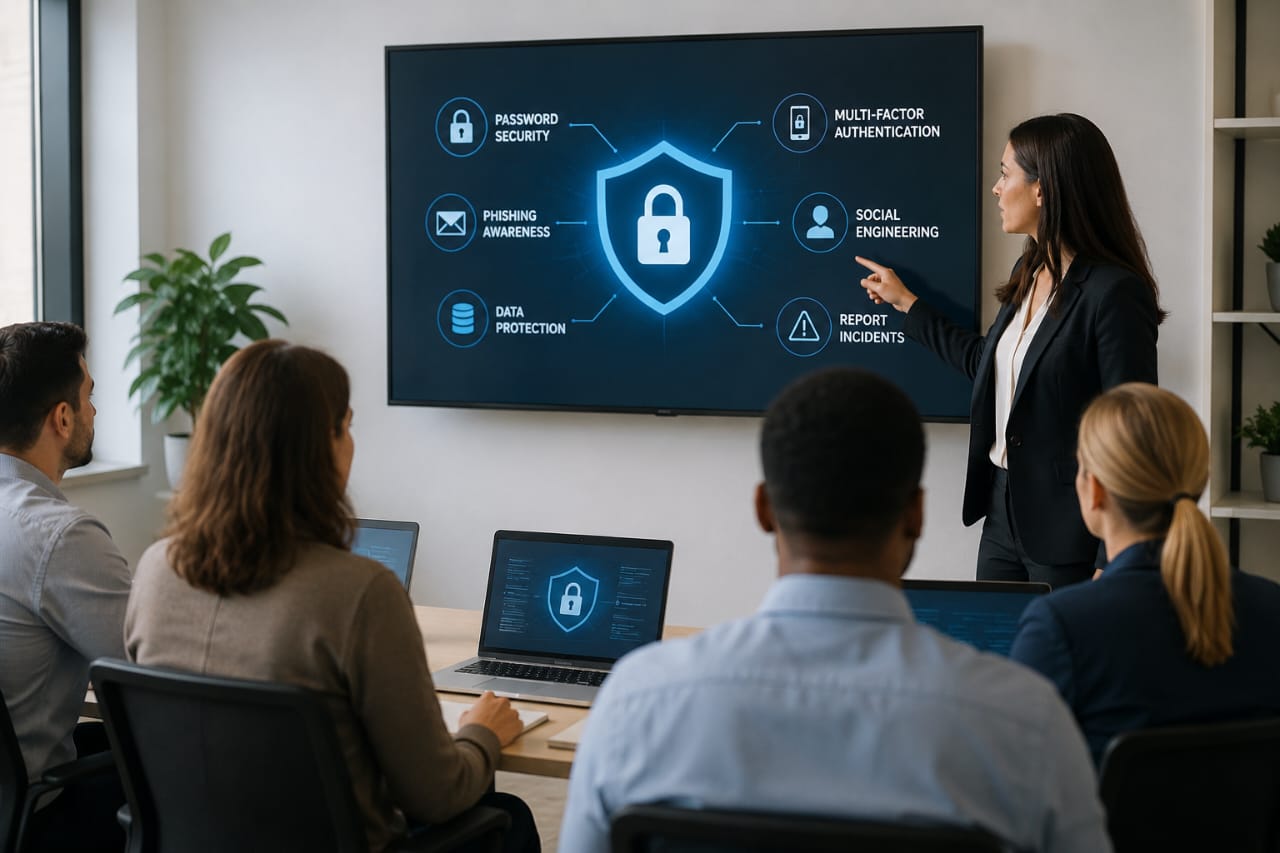
A business can have a modern firewall, endpoint protection, backups and multi-factor authentication and still be exposed by a single convincing message in an employee’s inbox. Verizon’s 2025 Data Breach Investigations Report found that the human element was involved in 60% of breaches it analyzed, while compromised credentials appeared as an initial access vector in 22% of breaches reviewed.
That changes how business leaders should think about cybersecurity training. It is not simply an annual compliance exercise or a short video employees click through before returning to work. Done properly, training helps people make safer decisions around email, credentials, customer information, cloud services and increasingly, artificial intelligence.
Growth creates more employees, more systems, more vendors and more data. It also creates more opportunities for a small mistake to become a costly interruption. Cybersecurity training helps a growing company build security into everyday work instead of leaving it entirely to the IT team.
Cybersecurity training protects the people behind the technology
Security products are designed to stop threats, but employees still interact with the systems those products protect. Someone receives a message that appears to come from a supplier, follows a login link and enters a password. Another employee gets an urgent request to change bank details. A manager receives a convincing message from an executive asking for sensitive information.
The Verizon 2025 DBIR shows why these scenarios deserve attention. Its research covered more than 22,000 incidents and 12,000 confirmed breaches. The report found that human involvement remained a major component of real-world breaches, while credential abuse continued to provide attackers with a common route into organizations.
Training gives employees a chance to recognize those patterns before the security team has to clean up the damage.
A breach can interrupt growth very quickly
Growth depends on businesses being able to serve customers, process payments, access internal systems and keep critical operations moving. A serious security incident can interfere with all of those activities at once.
IBM’s 2025 Cost of a Data Breach Report put the global average cost of a data breach at about $4.44 million. IBM also reported that 97% of organizations experiencing an AI-related security incident lacked proper AI access controls, while 63% lacked AI governance policies intended to manage AI or prevent shadow AI.
Those numbers do not mean training can prevent every breach, nor do they show that training directly increases revenue. The more defensible business case is simpler: training can reduce avoidable mistakes and help employees respond faster when something goes wrong.
AI makes cybersecurity training a business issue
Artificial intelligence has added a new layer to employee security responsibilities. Teams can now use AI tools to write emails, summarize documents, analyze data and automate work. That productivity can also create new risks when employees paste confidential information into an unapproved service or trust an AI-generated message too quickly.
In its 2026 Security Training Trends research, ISC2 reported that 73% of security leaders said their cybersecurity training budget had increased over the previous 12 months. AI was the leading training priority cited by 47% of organizations, followed by cloud security at 44%. The research also found that 70% of enterprises customize training by job role.
That last point is particularly useful. The finance team needs to understand payment fraud and business email compromise. Developers need secure coding and secrets management. Executives need to recognize impersonation, privileged-account abuse and increasingly convincing social-engineering attempts.
Small businesses cannot afford to treat training as optional
Smaller companies are often dealing with limited security budgets and lean IT teams. That makes clear employee guidance even more practical.
The Federal Trade Commission recommends regular staff training on common attacks, basic cyber hygiene and secure remote access. It also recommends giving employees a clear way to report suspicious messages and considering phishing simulations so staff can practice identifying scams.
Imagine an accounts employee receives an email requesting an urgent change to a supplier’s bank account. A good training program teaches the employee not simply to “spot phishing,” but to pause, verify the request through a trusted channel and report anything suspicious. That small procedure can be more useful than another generic presentation full of security terminology.
Training should be continuous and measurable
NIST’s SP 800-50 Revision 1 recommends a lifecycle approach to cybersecurity and privacy learning. The guidance is designed to support ongoing improvement, behavior change, role-based education and measurement rather than a one-time training event.
That means businesses should track what employees actually do, not just whether they completed a course.
- Phishing reporting rates
- Click rates during controlled simulations
- Repeat failures after retraining
- Time taken to report suspicious activity
- Completion rates by department or role
A useful program also keeps changing. New scams appear, business systems change and employees start using new platforms. Training should change with them.
Cybersecurity training also strengthens business resilience
ISC2’s 2025 Cybersecurity Workforce Study found that 59% of respondents faced critical or significant cybersecurity skills needs, while 88% reported at least one significant cybersecurity consequence associated with skills deficiencies.
Training can help close some of those gaps, particularly when it is aimed at the actual responsibilities employees have. It can also make security knowledge less concentrated inside a small IT or security department.
That becomes valuable as companies adopt cloud platforms, remote work, third-party services and AI systems. Security is no longer confined to a server room. It follows employees wherever business decisions and digital transactions take place.
What effective cybersecurity training should cover
A useful program does not need to overwhelm employees with technical detail. It should focus on decisions they are likely to face during ordinary work.
- Teach the basics: phishing, passwords, MFA, device security and safe handling of sensitive information.
- Add business-specific threats: invoice fraud, payment-change requests, vendor impersonation and business email compromise.
- Include AI risks: approved AI tools, confidential data handling, AI-generated scams and deepfake impersonation.
- Practice responses: show employees exactly who to contact and what to do after a suspected incident.
- Measure behavior: use simulations, reporting metrics and targeted retraining to identify weak areas.
Most importantly, training should never be treated as a substitute for technical controls. Businesses still need MFA, patching, backups, access controls, endpoint security, monitoring and incident-response plans. Employee awareness works best as one layer in a broader security program.
Cybersecurity training is really an investment in operational capacity
It is tempting to describe security training as an expense that produces no obvious return until an attack happens. A better view is to consider what a growing company needs from its workforce.
Employees need to know how to protect customer information, recognize fraudulent requests, use cloud and AI tools responsibly and escalate suspicious activity quickly. Those capabilities help reduce avoidable exposure while allowing the company to adopt new technology with clearer guardrails.
There is no credible basis for claiming that cybersecurity training alone produces a fixed percentage increase in revenue. Its business value is more practical: it can help protect the systems, information, trust and operational continuity that growth depends on.
For a company adding customers, employees and technology, that is a strong enough reason to stop treating cybersecurity training as a once-a-year obligation and start treating it as part of how the business operates.
References for further reading
- NIST SP 800-50 Rev. 1 — Building a Cybersecurity and Privacy Learning Program
- Verizon — 2025 Data Breach Investigations Report
- IBM — Cost of a Data Breach Report 2025
- ISC2 — 2026 Security Training Trends
- FTC — Cybersecurity for Small Business

Discover more from Aree Blog
Subscribe now to keep reading and get access to the full archive.