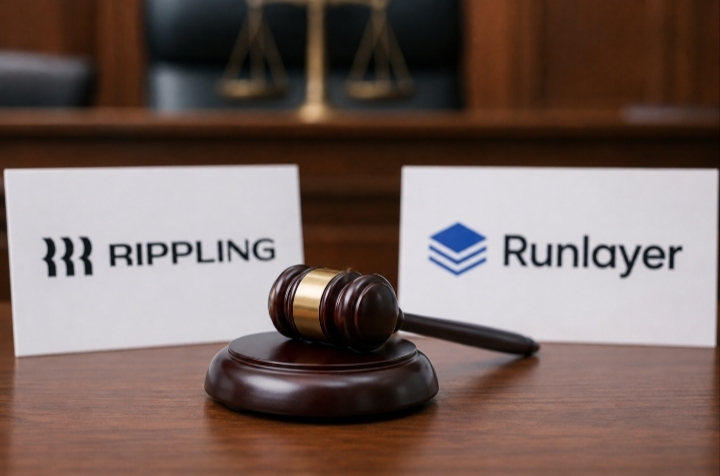
Rippling has filed a patent-infringement lawsuit against AI startup Runlayer, escalating a legal dispute that began last month when Runlayer accused the HR technology company of copying its MCP gateway product after a year-long commercial relationship.
The new lawsuit was filed Monday in the U.S. District Court for the District of Delaware. According to a report by Reuters, Rippling alleges that Runlayer infringes three of its patents related to data organization and automation. The filing was first reported by TechCrunch.
Rippling said Runlayer’s platform “infringes Rippling’s patents, steals its intellectual property,” and benefits from technology that Rippling spent years developing. The company is seeking damages and other patent-related remedies, arguing that the alleged infringement has caused lost sales, lost customers, and price erosion, according to court filings cited by Reuters and the New York Post.
Runlayer rejected the allegations. CEO and co-founder Andrew Berman described the lawsuit as “a desperate, retaliatory ploy to distract from the fact Rippling misappropriated our proprietary technology,” according to comments reported by the New York Post.
The patent case follows a lawsuit that Runlayer filed on July 28 in federal court in Manhattan. In that complaint, Runlayer accused Rippling of trade-secret misappropriation, breach of contract, and unfair competition after Rippling evaluated Runlayer’s technology and later decided to build its own MCP gateway.
Runlayer’s technology provides a security-focused MCP gateway that sits between AI agents and enterprise systems, adding controls such as authentication, authorization, policy enforcement, and auditing. The company has raised $42 million from investors including Khosla Ventures and Felicis, according to reports by Reuters and the New York Post.
Runlayer alleged that Rippling had access to confidential information during a nearly year-long partnership, including source code, deployment architecture, and other technical details shared under nondisclosure and trial agreements. The startup claimed the relationship broke down after Rippling refused to pay what Runlayer called a market rate for the platform.
The original complaint included a text message allegedly sent to Berman by a Rippling employee on June 12. The message said there was “a project internally to build essentially a clone of Runlayer” and that it was “almost a 1 to 1 copy of Runlayer.” The lawsuit also alleged that the employee suggested the project “smells like a Parker thing,” referring to Rippling CEO Parker Conrad.
Rippling has denied using Runlayer’s intellectual property. In comments reported by TechCrunch, a company spokesperson said Rippling is launching “a superior product for connecting AI tools to business data using only our proprietary information.”
The company has acknowledged that it is building its own MCP gateway product, but it argues that the product was developed independently.
A notable development in the case is a declaration from Tim Fall, the Rippling engineer whose text messages were quoted in Runlayer’s complaint. In a later court filing, Fall said that after seeing and using Rippling’s MCP Gateway, he no longer believed it was a clone of Runlayer’s product.
“Now that I have seen and used Rippling’s MCP Gateway, it is clear to me that it is not a ‘clone’ and did not copy the Runlayer MCP Gateway,” Fall wrote, according to the New York Post. He also said he did not recall receiving “any source code, system architecture, or back-end details for the Runlayer MCP Gateway” during the companies’ relationship.
Rippling has argued in court that with Fall’s earlier message “debunked,” Runlayer lacks evidence that trade secrets were shared or used.
The dispute is now proceeding on two separate legal tracks:
- Runlayer v. Rippling (S.D.N.Y.) — trade-secret misappropriation, breach of contract, and unfair competition.
- Rippling v. Runlayer (D. Delaware) — infringement of three Rippling patents related to data organization and automation.
The specific patent numbers asserted by Rippling had not been identified in the public reporting available Monday.
The case is drawing attention because it involves the rapidly growing market for infrastructure that connects AI agents to enterprise software and data. The Model Context Protocol (MCP), introduced by Anthropic in 2024, has become an emerging standard for those connections, and companies are competing to provide the security and governance layer around it.
The litigation also adds to Rippling’s broader portfolio of intellectual-property disputes. Reuters noted that the company is already involved in a separate legal battle with rival HR platform Deel over allegations of corporate espionage and trade-secret theft.

Discover more from Aree Blog
Subscribe now to keep reading and get access to the full archive.