A renewed push to return humans and cargo to the lunar surface has taken shape around private companies and government partners.
At the center of that effort is Jeff Bezos’s aerospace venture, Blue Origin, which has shifted its priorities toward landing on the Moon. That move forms part of a broader scramble by U.S. commercial firms to accelerate lunar capability as China advances its own lunar timeline.
Reporting on recent developments has appeared in outlets including Reuters and Space.com, which together sketch a picture of competition, government funding and differing strategies among rival companies.
Blue Origin’s New Focus
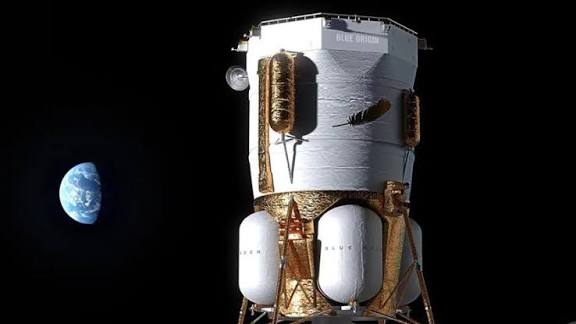
Blue Origin has signaled a deliberate shift from short suborbital tourism flights toward the development and testing of a lander designed to deliver cargo and, eventually, people to the lunar surface.
The company has moved personnel and resources away from other programs to concentrate on that lander, and has begun sending the vehicle through thermal and vacuum testing used to validate hardware for space environments.
These steps aim to prepare the lander for an uncrewed mission that would demonstrate it can touch down on the Moon, a key milestone before any crewed operations could be contemplated.
The contest between wealthy founders and their companies has become a driving force behind new milestones. Elon Musk’s firm, SpaceX, has also pushed aggressively on lunar ambitions, and public comments from both sides have emphasized different approaches: one favoring rapid, iterative testing and the other highlighting a more measured, methodical path.
Coverage in outlets such as Business Insider and Investing.com has framed the rivalry as a narrative that complements official national plans rather than replacing them.
The Government Partner: NASA and Artemis
NASA remains a central actor in U.S. lunar efforts, funding and coordinating commercial partners to deliver capabilities that support the agency’s goals. The Artemis program is intended to return astronauts to the Moon and build sustainable operations that can support future missions beyond lunar orbit.
As part of that framework, NASA is supporting commercial lander development to ensure multiple suppliers and technologies can contribute to a sustained presence. The interplay between private development and NASA procurement choices is a major factor shaping which systems move fastest from tests to launch.
China’s space program has publicly outlined ambitions to carry out significant lunar missions by around 2030. That timeline has become an implicit benchmark for U.S. public and private actors and helps explain why companies are accelerating development and seeking visible milestones.
Unlike the Cold War model of state-only competition, the present moment blends government programs with privately financed efforts, creating a hybrid race in which commercial pace and government policy interact.
What Progress Looks Like Now
Practical milestones the companies are pursuing are straightforward: assembling and testing flight-ready landers, running environmental trials to validate hardware, securing NASA funding contracts that support additional development, and scheduling uncrewed demonstration launches.
Blue Origin has reportedly completed or shipped components for environmental testing, an important step before any mission is cleared to fly. Meanwhile, other companies are refining launch systems, crew and cargo interfaces, and mission profiles that could be used in support of Artemis objectives or in commercial missions driven by private customers.
What remains uncertain
Public reporting focuses on demonstrable steps; tests completed, contracts awarded, and planned uncrewed flights, and deliberately avoids speculation about outcomes.
Questions that remain open include exact launch dates for uncrewed lander demonstrations and the timeline for crewed missions, both of which depend on successful test results and additional scheduling decisions by NASA and the companies involved.
The combination of private funding, government contracts, and a clear external benchmark in China’s lunar program has created a rare moment of convergence in which multiple actors are pushing to demonstrate tangible capability on the Moon.
For the companies involved, visible success on uncrewed missions will not only validate engineering but also strengthen commercial credibility and open further opportunities for government and private customers.

Discover more from Aree Blog
Subscribe now to keep reading and get access to the full archive.