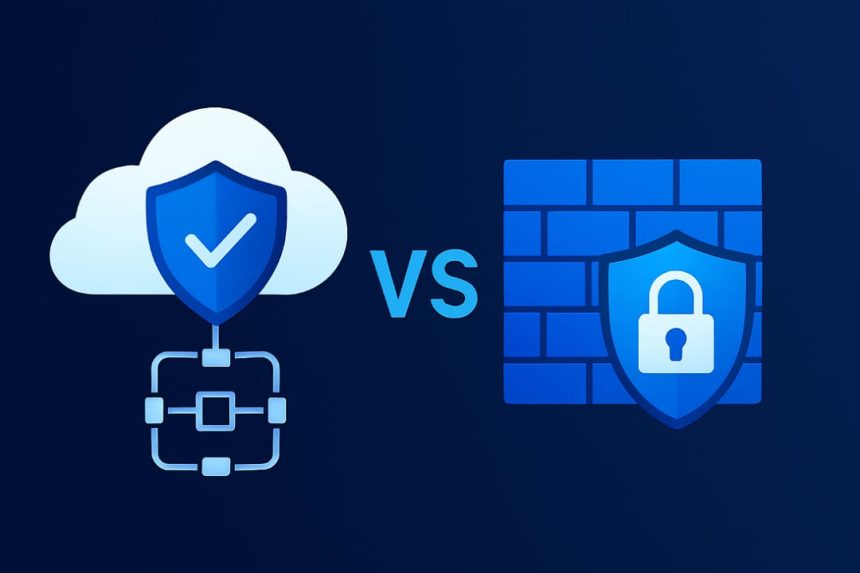
When an IT leader asks “SASE vs perimeter security, which should we choose?” the conversation usually starts with the same few, practical problems: people working from many places, apps living partly in the cloud, and a growing cost in keeping traffic routed through a single office.
What is SASE?
SASE stands for Secure Access Service Edge. It combines networking and security into a cloud-delivered service: things that used to live in separate boxes (routing, WAN optimization, web filtering, firewalling, and identity-aware access) get delivered from a network of cloud points-of-presence (PoPs) instead of from a single on-premises data center.
That shift lets an employee in a small office or on the road connect to the nearest secure PoP and reach the apps they need faster and with a single set of policies. Gartner’s definition of SASE highlights this convergence of SD-WAN and cloud security functions such as ZTNA, SWG, CASB and FWaaS.
What SASE and Perimeter Security Looks Like
Perimeter security is the older pattern most organizations learned first. It treats the corporate network as a defended zone: traffic from the outside crosses a clear boundary where firewalls, intrusion detection systems and VPN gateways inspect and control connections.
If you’re in the office, your device is “inside” and often allowed broader access. If you’re remote, you typically tunnel back into that perimeter via VPN. That hub-and-spoke flow can be predictable, but it creates delays and operational strain when many users and cloud apps are involved.
SASE flips that model. Enforcement happens at the edge (close to the user or device) with decisions driven by identity and device posture rather than by whether a packet crossed a particular wire.
The goal is to give users direct, short paths to the apps they use while keeping the same policies applied everywhere. Vendor resources and architectural summaries explicitly show this move away from central backhaul toward distributed enforcement.
SASE vs perimeter security: Strengths and Limits
Both approaches solve real operational problems, but they do so in different ways.
Perimeter security strengths
- Predictability: If most apps and data live inside one or two data centers, a perimeter is straightforward to operate and audit.
- Control over hardware: Appliances and physical controls are in your hands, which some compliance frameworks prefer.
Perimeter security limits
- Scalability: Each new office, remote user, or SaaS app increases the load on central appliances or forces complex exceptions.
- User experience: Backhauling remote traffic through a central data center adds latency, and VPNs add management overhead.
SASE strengths
- Consistent policy at scale: Policies follow identity and device state, enforced at distributed PoPs close to users.
- Better fit for cloud/SaaS: Direct, proximate access to cloud apps avoids unnecessary detours through a corporate hub. Vendor guides and most SASE product pages emphasize this as a primary design choice.
SASE limits
- Provider footprint: Performance depends on how many PoPs a provider runs in your geographic regions. Poor coverage shows up as lag.
- Organizational change: Teams must shift from appliance-focused operations to cloud-first monitoring and policy management.
Step-by-Step Migration Path From Perimeter Security to SASE
Switching everything overnight is unnecessary, and risky. Most organizations mix models for years. Here’s a common sequence that moves an organization safely from perimeter-first to a SASE-led setup.
Start with inventory and traffic mapping. Know where your apps live (SaaS, public cloud, private data center), how users connect today, and which flows have tight latency or compliance requirements. That map tells you which workloads are safe to move first.
Pilot the security edge for web and SaaS. Many teams begin by rolling out Secure Service Edge (SSE) components, secure web gateway, cloud access security broker, and zero-trust network access, to a subset of users. This gives protection for internet and SaaS traffic without touching critical data-center paths. Vendor guidance often recommends SSE as a logical first step.
Add SD-WAN or route management next. Once web and SaaS traffic are controlled by the security edge, branch connectivity can be shifted to SD-WAN overlay and connected to the same control plane. That reduces the number of tunnels and simplifies network routing.
Keep a secure tunnel to the data center while you migrate on-prem apps. For applications that cannot immediately move or be re-architected, maintain controlled backhaul to the existing perimeter, and route only what’s necessary through it.
Measure at every stage: latency, error rates, authentication failures, and user help-desk volume. The best vendor pilots include PoP maps and SLAs so you can compare real-world performance against your needs. Cisco, Palo Alto, and Cloudflare documentation all stress phased rollouts and performance testing.
Key Questions to Ask When Evaluating SASE or SSE Vendors
When you evaluate options, the right questions are practical and measurable.
Ask vendors about their PoP footprint and the expected round-trip times from your major user locations. Insist on a clear description of how they perform TLS inspection and what data is logged or retained.
Check how a SSO provider, endpoint management tools, and your SIEM will integrate with their control plane. And get pricing examples that reflect the mix of heavy and light users you have.
From the internal team, get clarity on which apps must stay on-prem for the next 12–24 months and what the team’s capacity is for operational change.
Moving to a cloud-delivered model shifts monitoring, incident response, and policy planning; staff training and process updates should be budgeted accordingly. These are practical trade-offs that organizations cite as they plan pilots.
Common Missteps and How to Avoid Them
One frequent misstep is treating SASE as a single cloud firewall you can swap in overnight. SASE is a service model that involves identity, global control planes, and distributed enforcement; skipping performance tests or identity integration creates surprises.
Another is rushing a single-vendor consolidation without a proof of concept, vendor features and PoP reach vary, and something that looks complete on paper can reveal gaps under load. Published vendor materials and analyst write-ups repeatedly recommend phased evaluation.
A different and subtle error is not planning for compliance and logging needs early. If your auditors expect certain packet logs or if you must retain traffic records for legal reasons, clarify how those requirements map to a cloud-centric model and whether logs will live in the vendor cloud or forwarded to your SIEM.
How to Decide: Yhree Signals that Point Toward SASE
If you recognise at least two of these, a pilot makes sense:
- Your majority of application traffic goes to SaaS or public cloud rather than internal data centers.
- A significant portion of staff work from home, remote offices, or multiple countries.
- The help desk spends a growing share of time managing VPNs and remote access.
If none of those apply, and your apps are tightly centralized and heavily regulated with physical controls, a perimeter-first model can still be the right approach for the near term. Either way, hybrid models are common and often the practical choice for multi-year transitions.

Discover more from Aree Blog
Subscribe now to keep reading and get access to the full archive.