The way people find information online is changing again. If traditional SEO was about getting your link on page one, the new frontier is about being cited by the tools that summarize that page for users, AI-powered search and large language model (LLM) results pages. These are the systems behind Google’s AI Overviews, Bing Copilot, ChatGPT’s browsing answers, and tools like Perplexity.
I’ve seen this transformation up close. In one client’s analytics dashboard, traffic from Google AI Overviews quietly overtook their clicks from organic results in a single quarter. At first, they thought it was a bug. It wasn’t. It was the new shape of visibility.
What Makes Content Extractable to AI Systems
When you type or speak a query into one of these systems, you’re no longer seeing ten competing links. You’re seeing a single paragraph, sometimes two, often framed as a confident summary that cites a few sites underneath.
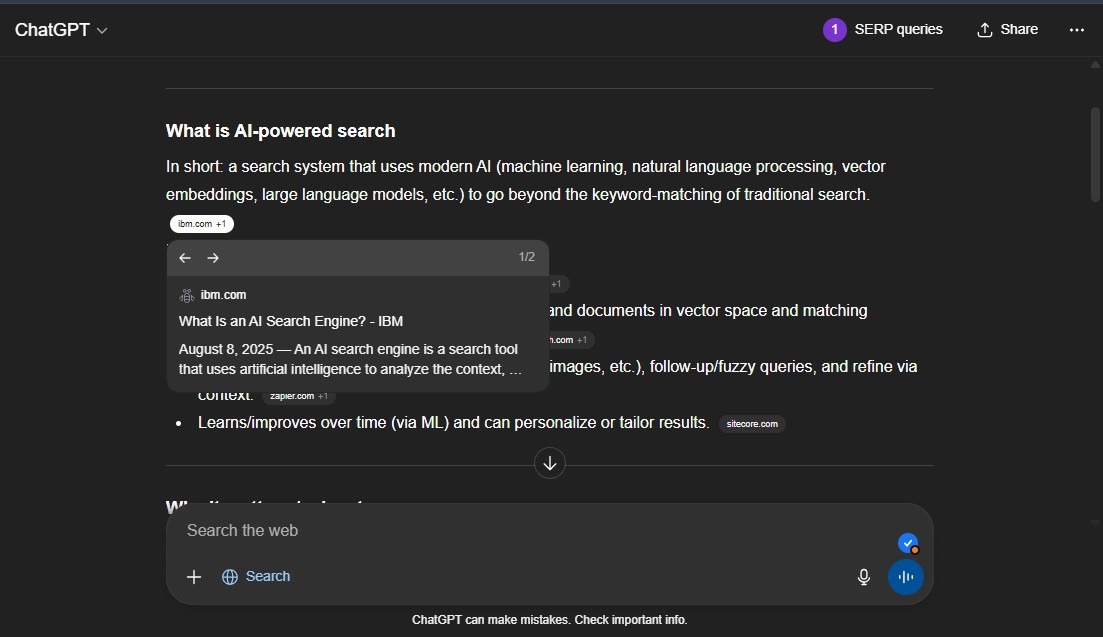
Those citations are the new currency. Being among them signals that your content helped the AI craft its answer.
This isn’t some distant idea. It’s a real shift, from chasing rankings to earning recognition. It calls for a new kind of optimization that stays clear to people and readable to machines.
In practice, AI-powered search favors content that’s easy to extract, concise in its key points, and written by someone credible. Think of it as writing for both a reader and an assistant that’s trying to explain your ideas to someone else.
What shapes LLM-Generated Answers
When large language models decide what to include in a synthesized answer, they draw from what’s publicly available and easily parsed. They don’t “crawl” the web in real time the way traditional search engines do; instead, they blend search index data with live signals from crawlers, APIs, and structured markup.
Several patterns influence what they surface:
- Clarity and structure. The easier it is for an AI to isolate an idea (through clear headings, short sections, or direct phrasing) the more likely that snippet can be reused in a generated response.
- Authority signals. Author names, sources, publication dates, and citations give the model something to trust. Google and Bing both use these cues to determine reliability.
- Recency. Generative systems are more likely to quote up-to-date material. Even if your content is evergreen, refreshing it signals to both crawlers and users that it’s still maintained.
- Technical accessibility. Clean HTML, schema markup, and canonical links make it easier for AI systems to read and interpret your page.
Building for Clarity, Not Just Keywords
For years, SEO advice focused on density, backlinks, and meta descriptions. Those still matter, but AI-powered search is teaching us to think in smaller units: the answerable paragraph.
When I rewrite content for clients now, I focus on clarity at the paragraph level. Each section should stand on its own, capable of being lifted and quoted without losing sense. That means:
- Write subheadings that echo how users actually phrase questions.
- Start each section with a short, direct answer, then unpack the reasoning below.
- Keep examples close to the text, they help both readers and AI models ground your point.
It’s not about stripping away personality or depth. It’s about making your ideas portable enough that even a summarization model can’t distort them.
The New Signals of Expertise
In the world of LLM results, trust is built through transparency. A generic “About” page doesn’t count as proof of expertise anymore. These models look for signs of real authorship: names, credentials, consistent publication tone, and evidence of original thought.
When I wrote about brand management early in my career, I never thought to include my name. It felt unnecessary. Now, those pages look anonymous compared to current best practices. Adding an author bio and a short note on experience does more than help readers, it gives the algorithm a clearer sense of accountability.
This is part of Google’s larger framework: Experience, Expertise, Authoritativeness, and Trustworthiness (EEAT).
In AI-powered search, these qualities help models determine whose explanation is worth citing. Small gestures like linking to your own prior research, showing revision dates, or referencing credible sources, create a breadcrumb trail of reliability.
Structuring Content for LLM Interpretation
Let’s get practical. Structuring a page for AI-powered search doesn’t mean over-optimizing. It means reducing friction for the model that’s scanning your text.
- Use semantic HTML. Proper heading hierarchy (H1 → H2 → H3) helps machines understand topic relationships.
- Add structured data. JSON-LD schemas for articles, FAQs, or products make your page easier to interpret. They’re not new, but they’ve become more critical now that AI systems use them as training references.
- Include short summaries. A one- or two-sentence overview at the top of a page gives both readers and models an easy hook.
- Keep URLs stable. LLMs cache and reference pages over time. Constant changes or redirects can cause a loss of citation continuity.
You can even publish an optional llms.txt file (an emerging standard similar to robots.txt) to indicate which parts of your site you want large language models to learn from. It’s early days for that file, but some major content platforms have already adopted it.
Writing in a Way Machines Can Quote
Here’s something I learned the hard way: AI systems tend to pull sentences that stand well on their own. If your argument takes eight lines to land, the model may cut it halfway and misrepresent it.
To guard against that, try weaving mini-conclusions throughout your piece. Each section should have at least one line that could make sense out of context. For example, instead of:
“These shifts are changing the nature of visibility online.”
Try:
“AI-powered search is reshaping visibility by turning pages into sources, not just destinations.”
That’s a sentence an AI can quote without losing your intended meaning.
Building Visibility Beyond Clicks
One surprising outcome of this new search landscape is that impressions may rise while clicks fall.
People often get what they need from the AI summary and never visit the site. It can feel discouraging until you reframe what success looks like.
Your presence in the AI answer still influences perception and discovery.
Users may not click immediately, but repeated exposure to your brand in summaries builds recognition. That recognition often surfaces later, in branded searches, email sign-ups, or direct visits.
A friend who runs a travel information site told me their AI-generated mentions now drive more direct bookings than their blog ever did. Their pages are cited in ChatGPT and Bing summaries, and users later return to the site by name.
Tracking What You Can’t Yet Measure
Analytics tools are catching up slowly. A few platforms (like Wix’s AI Visibility feature and third-party trackers) are experimenting with ways to detect when your site is mentioned or cited in AI results. For now, though, most of your insight will come from manual observation.
Keep an eye on referral patterns, new branded searches, or unusual traffic spikes from unexpected sources. These often hint at AI citations. You can also use search operators to find where your content is referenced across platforms.
The key is to track visibility, not just traffic. The influence of being cited in an LLM answer extends beyond immediate clicks, it shapes how your content is used to explain a topic at scale.
Refreshing Old Vontent for the New Search
You don’t have to start from scratch. Most sites already have pages that perform well in traditional SEO. The goal is to refactor them for AI readability:
- Add short summaries to the top of cornerstone articles.
- Clarify outdated phrasing and ensure every claim has a clear source.
- Break dense sections into digestible paragraphs, each anchored to a single question or concept.
- Update timestamps and author bios for transparency.
This process takes time, but it compounds.
Balancing Accessibility and Ownership
A fair concern many creators raise is: “If AI models use my work to answer questions, am I just training my competition?” It’s a valid fear, especially when credit is inconsistent.
Right now, transparency is improving. Google’s AI Overviews, Bing, and Perplexity all cite their sources directly. The more structured and recognizable your content, the easier it is for them to credit you properly. And by ensuring your site’s brand and voice are clear, even paraphrased mentions still trace back to you.
The guiding principle is this: make your content the definitive explanation of its subject. If your version becomes the one models rely on, you retain authority, whether users arrive through a citation or a direct visit.
The future of optimization with AI-Powered Search
Optimizing for AI-powered search is a moving target. The technology will evolve, but the underlying goal will not: write information that can stand on its own, backed by real expertise and accessible signals.
In a sense, this shift returns us to the roots of the web, clear, verifiable knowledge shared openly. The twist is that we now write with a second reader in mind: the machine that translates our words into a synthesized answer for someone else.
If you build for both, you’ll stay visible, credible, and useful, no matter how search changes next.

Discover more from Aree Blog
Subscribe now to keep reading and get access to the full archive.