
In a study of 75,000 brands, Ahrefs found that branded web mentions had a 0.664 correlation with visibility in Google AI Overviews, compared with 0.218 for backlinks. That is a striking number, but it does not prove Google has created a new “brand citation” ranking factor.
It does show something more useful: being talked about across the web is closely associated with being visible in AI-powered search. Ahrefs’ study provides the underlying methodology and data.
“Brand citations,” “brand mentions,” “implied links,” and “AI citations” are often treated as if they describe the same thing. They do not. An unlinked mention of a company is different from a backlink, and both are different again from an AI system citing a webpage as evidence for an answer.
Google has not confirmed such a system. In fact, Google has previously said that it does not treat ordinary unlinked mentions like links. What has changed is the role of third-party information in modern search, particularly when Google’s AI systems assemble answers from multiple sources.
Google Has Not Confirmed “Brand Citations” as a New Ranking Factor
There is an old SEO assumption that if another website mentions your brand without linking to it, Google can treat that mention like a backlink.
Google’s John Mueller pushed back on that idea directly. In a 2021 discussion, he said Google did not use ordinary brand mentions for things such as PageRank or understanding the link graph. He also pointed out the difficulty of interpreting mentions because context can be positive, negative, sarcastic, or spammy.
That does not mean a mention is useless. Someone can read about your company in an article, search for the company by name and become a customer. A mention can also exist inside an ecosystem of information that search systems use to understand entities. The mistake is jumping from that observation to “every mention passes ranking equity.”
The Google Patent That Keeps Getting Pulled Into This Debate
Part of the confusion comes from a Google patent called Ranking Search Results. The patent describes “express links” and “implied links.” An express link is a conventional hyperlink. An implied link is described as a reference to a target resource without an express hyperlink. The system also discusses “reference queries” and a modification factor that can influence ranking scores.
It sounds almost identical to the modern brand-mention theory.
There is a catch: a patent describes a technology that was patented, not necessarily a system that is currently running in Google’s production search results. The patent also deals with reference queries and groups of resources, which makes it too simplistic to cite as proof that Google currently awards ranking credit for every unlinked brand mention.
So the patent is useful background, but it is not the smoking gun some SEO articles make it out to be.
What Has Changed With AI Search
This is where the evidence becomes much stronger.
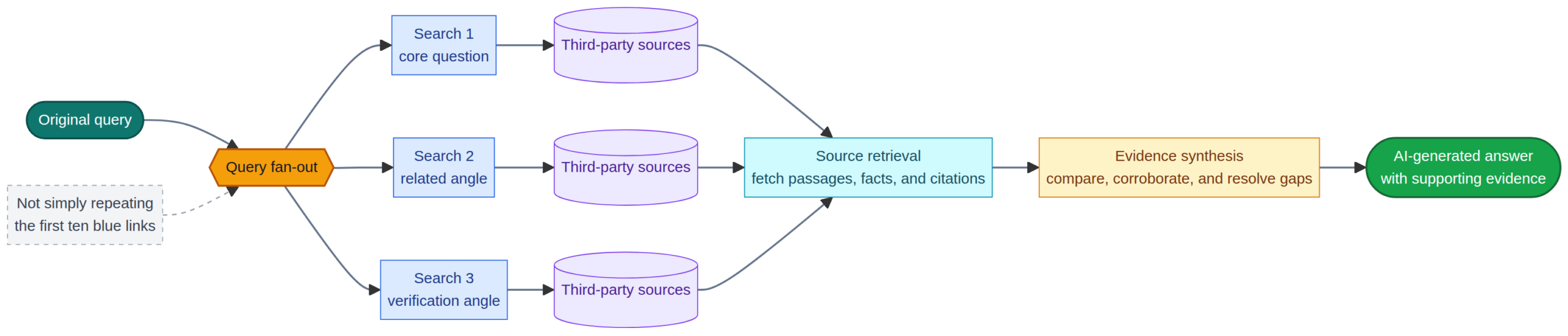
Google’s current guidance on generative AI features says AI Overviews and AI Mode remain rooted in Google’s existing Search ranking and quality systems. Google describes retrieval-augmented generation, where search systems retrieve relevant pages from the index, and query fan-out, where the system generates related searches to gather information from different angles.
Google also states that AI features continue to use the same foundational SEO requirements as conventional Search. A page generally needs to be indexed and eligible to appear in Google Search before it can be used as a supporting link in AI Overviews or AI Mode.
That second mechanism is especially important. Imagine someone asks an AI search system, “What are the best enterprise identity platforms for African businesses?” The system does not necessarily rely on one search result. It can break the question into related searches, retrieve additional pages and then assemble an answer.
Suddenly, your visibility depends on more than your own homepage ranking for one phrase. The wider web becomes part of the evidence pool.
75,000 Brands Reveal a Strong Correlation
Ahrefs examined 75,000 brands to identify factors associated with visibility in Google AI Overviews. Branded web mentions produced the strongest correlation in the study at 0.664.
Other measures were considerably lower:
- Branded web mentions: 0.664
- Branded anchors: 0.527
- Branded search volume: 0.392
- Domain Rating: 0.326
- Referring domains: 0.295
- Backlinks: 0.218
Ahrefs defined branded web mentions as mentions of the brand name anywhere across the web, whether linked or unlinked. It also filtered its sample to domains with a Domain Rating above 40 and a highest-volume keyword with at least 800 monthly searches. The researchers then compared those brands with millions of AI Overview responses.
Those numbers are worth paying attention to, but they need one big footnote: correlation is not causation. A widely known company naturally attracts more articles, reviews, links, searches and videos. The mentions may be partly a result of existing popularity rather than a cause of higher AI visibility.
Traditional Rankings and AI Citations Are Increasingly Different
Another Ahrefs analysis looked at millions of AI Overview citations and compared them with conventional Google rankings.
Its March 2026 update found that only about 38% of pages cited in AI Overviews also ranked in Google’s top 10. Ahrefs also reported that 18% of non-ranking citations in its analysis came from YouTube.
That finding changes how I would think about content visibility. A page can be relevant to an AI answer even when it is not one of the conventional top ten results for the original query.
Google’s AI search systems can issue related searches and identify additional supporting pages while generating a response.
Third-Party Sources Are Doing a Lot of the Work
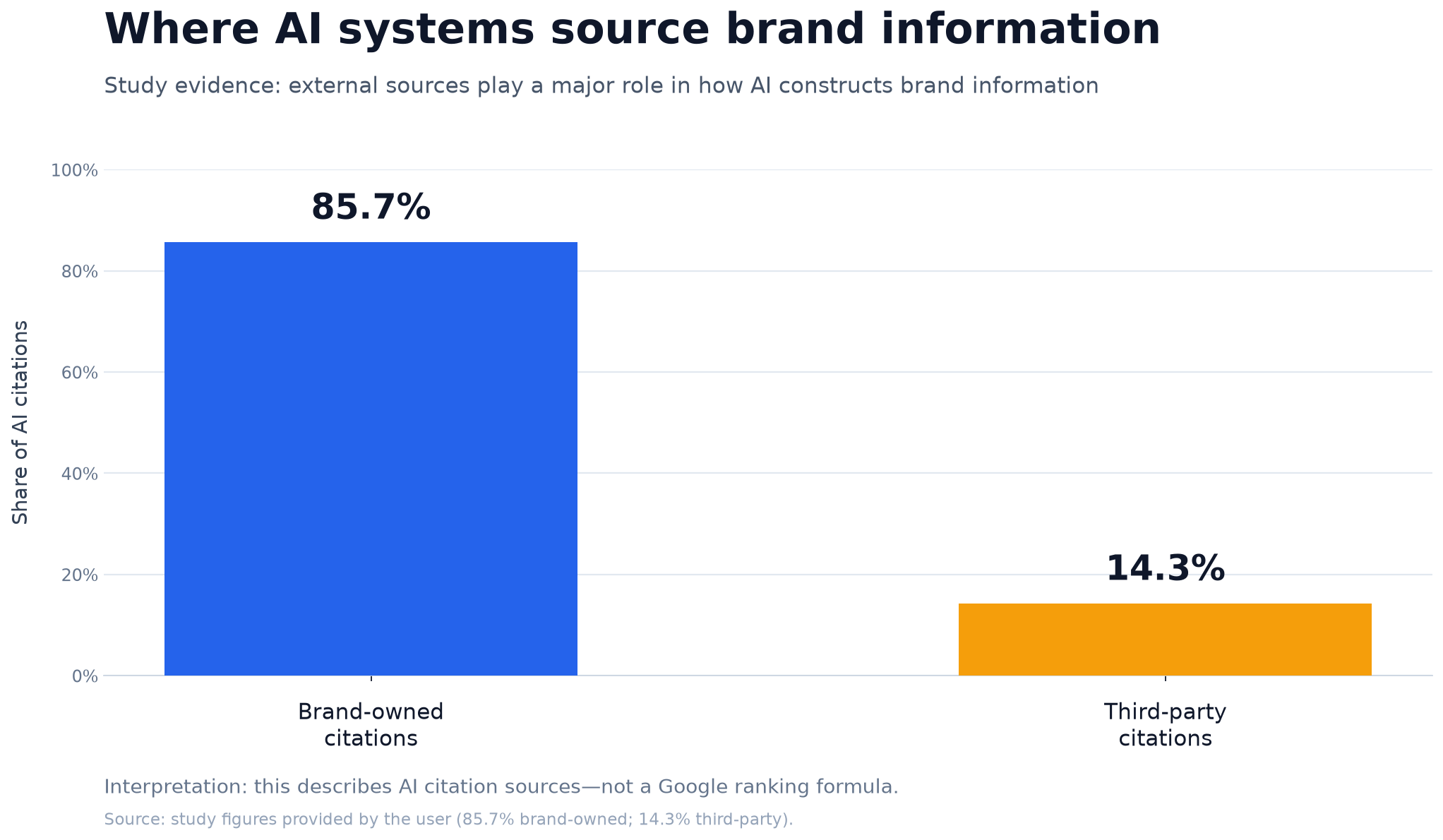
A 2026 academic study looked at 167,551 URL-grounded citations across 128 brands, 12 home markets and 13 languages. The researchers found that 85.7% of citations pointed to third-party sites, while only 14.3% pointed to brand-owned websites.
That is a useful reality check for companies that spend all their effort polishing their own website.
Your website can explain exactly what your company does. But an AI system answering “What do people say about this company?” may rely heavily on information published somewhere else.
The same study found that 80% of citations came from roughly 18% of domains, showing that the source ecosystem was concentrated rather than evenly distributed across the web. Wikipedia was the most-cited domain in 11 of the 12 languages examined.
Google Is Already Using Citation Relationships in Search
There is another useful piece of evidence in Google’s own documentation.
Google’s topic authority system for news looks at several signals to understand which publications are authoritative for particular subjects and locations. Google specifically says its systems examine how original reporting is cited by other publishers to understand influence and authority on a topic.
That does not prove a universal brand-citation ranking score. It does show that citation relationships can be an explicit input into particular Google Search systems.
The distinction is worth preserving. A citation signal used to understand news-source authority is not the same thing as a generic “brand mentions boost rankings” mechanism.
Entity Understanding Is Another Piece of the Puzzle
Google’s Organization structured-data documentation says that organization markup can help Google better understand an organization and disambiguate it from other organizations. Google supports properties such as url, sameAs, identifiers and other organizational information for this purpose.
This is a different mechanism from ranking a page because another site mentioned a brand.
But it points toward a broader reality: modern search systems need to identify the entities behind pages, products and organizations. Consistent information across the web can make that identification easier.
What This Means for SEO
The practical lesson is not to chase hundreds of mentions.
Google explicitly warns against pursuing inauthentic mentions as a generative-AI SEO tactic. Its guidance continues to emphasize helpful, reliable, people-first content and established SEO fundamentals.
A better strategy is to create information other people have a reason to reference.
- Publish original data. Surveys, benchmarks, experiments and first-hand research give journalists and industry writers something concrete to cite.
- Build genuine third-party coverage. Relevant reviews, interviews, industry articles and expert commentary provide context around your brand.
- Keep entity information consistent. Use Organization structured data where appropriate and provide accurate identifiers, URLs and related profiles.
- Measure AI visibility separately. Ranking reports alone do not show whether AI systems mention or cite your company.
Think about a small software company launching a new security product. A homepage saying “We are an enterprise cybersecurity platform” is easy to produce. A technical benchmark showing how the product handled 50,000 authentication requests, followed by independent coverage and expert commentary, creates a much richer information trail.
The second example gives search systems more material to connect: company, product, capability, evidence and independent references.
So, Is Brand Citation a New Ranking Signal?
Not in the way the phrase is often presented.
There is no public confirmation that Google has introduced a universal score where an unlinked mention gives a website a fixed ranking benefit. Google’s previous statements point in the opposite direction when the claim is that mentions should be treated like links.
But dismissing brand citations altogether would also be a mistake.
AI search systems are retrieving information from a wider set of sources. Google’s own documentation confirms that AI Overviews and AI Mode use its existing Search systems to retrieve relevant web content and can use different retrieval techniques. Large-scale research shows a strong relationship between brand mentions and AI visibility. Independent research shows that third-party websites supply most of the URL-grounded citations used for brand information in the studied AI systems.
The useful conclusion is less flashy but more defensible: brand presence across credible parts of the web is becoming increasingly valuable for search visibility, especially in AI-generated results, without there being evidence of a simple “mention equals ranking boost” formula.
References for Further Reading

Discover more from Aree Blog
Subscribe now to keep reading and get access to the full archive.