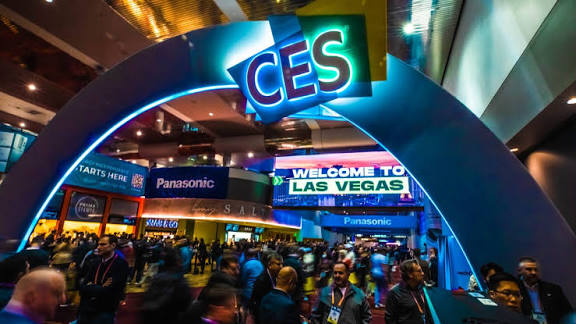
CES 2026 opened in Las Vegas this week as technology companies from around the world gathered to present new consumer electronics, software, and prototypes.
The event runs from January 6 to January 9, with major announcements arriving ahead of the public show floor opening.
Artificial intelligence is a central focus of this year’s exhibition, with manufacturers emphasizing its integration into household appliances, vehicles, and personal devices. Rather than showcasing standalone AI products, many companies are positioning AI as an underlying system meant to coordinate multiple devices and functions across homes and cars.
LG drew attention with demonstrations of its CLOiD home robot, designed to assist with domestic tasks such as laundry handling and food preparation. The company presented the robot as part of a broader smart-home ecosystem, where appliances and devices communicate through AI-driven coordination rather than operating independently.
Samsung focused its CES presence on home entertainment and connected living. The company introduced a 130-inch Micro RGB television and outlined its vision for AI-powered home environments, where televisions, appliances, and sensors work together to adapt to user routines. Samsung also highlighted expanded use of AI across its appliance lineup.
Display technology remains a major attraction at CES. LG unveiled an ultra-thin television measuring approximately 9 millimeters, reinforcing the company’s emphasis on form factor and panel innovation alongside image quality improvements.
Automotive technology is another major theme at the show, though with a noticeable shift in emphasis. According to Reuters, automakers and suppliers are highlighting self-driving systems, driver assistance software, and AI-based vehicle intelligence, while scaling back the number of new electric vehicle announcements compared to previous years.
Industry analysts covering the event note that CES 2026 reflects a broader trend toward embedding AI directly into consumer hardware, rather than presenting it as a separate product category.
From home robotics to vehicles and entertainment systems, AI is being positioned as infrastructure that supports everyday functions.
CES is widely viewed as an early indicator of the technologies likely to reach consumers later in the year. As the event continues, attention is expected to remain on how companies translate AI-driven concepts into products that can be deployed at scale.

Discover more from Aree Blog
Subscribe now to keep reading and get access to the full archive.