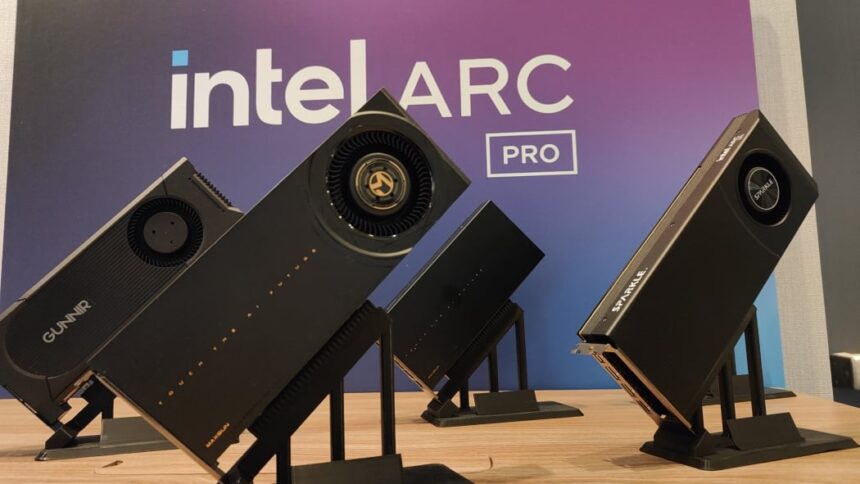
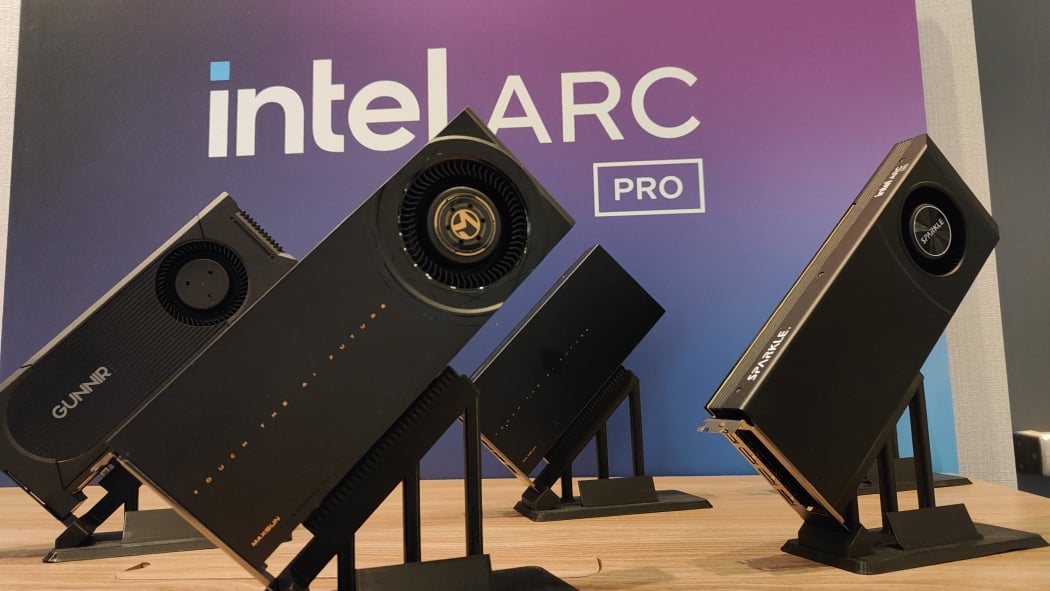
GUNNIR has demonstrated a dual-GPU workstation built around two Intel Arc Pro B70 graphics cards, combining 64GB of aggregate GPU memory with liquid cooling in a desktop system aimed at local artificial intelligence workloads.
The workstation was shown at Intel Connection 2026 in Suzhou, held on September 22 and 23 at the Suzhou International Expo Center in China.
GUNNIR, also known as 蓝戟, displayed two workstation designs using Intel Arc Pro B70 graphics. The larger system uses two B70 cards and liquid cooling, while a smaller design uses the Arc Pro platform with vapor-chamber cooling.
The dual-GPU configuration uses two 32GB Arc Pro B70 cards, giving the workstation 64GB of aggregate graphics memory. That figure represents the combined memory of two separate GPUs rather than a single 64GB graphics processor.
Intel lists the Arc Pro B70 with 32 Xe cores, 256 Xe Vector Engines, 256 XMX AI engines and 32 ray-tracing units. The GPU provides 22.94 TFLOPS of FP32 performance and 367 INT8 TOPS, according to Intel’s Arc Pro B70 specifications.
The card carries 32GB of GDDR6 memory on a 256-bit interface, with memory bandwidth rated at 608GB/s. Intel also lists ECC support, PCIe 5.0 x16 connectivity and a maximum dynamic clock of 2.8GHz.
The B70 has a typical board power of 230W, while Intel specifies a configurable power range from 160W to 290W. Two cards therefore represent about 460W of nominal GPU board power before the processor, motherboard, memory, storage and cooling system are included.
GUNNIR’s dual-card machine uses Intel’s Core Ultra 200HX platform, according to reporting from VideoCardz and IT之家.
Intel positions the Arc Pro B70 for local AI inference, professional workloads and multi-GPU deployments. Its documentation also describes Linux multi-GPU support and the use of Intel’s oneAPI software stack for supported workloads.
The company’s Arc Pro B-series documentation describes multi-GPU configurations as a way to increase aggregate memory capacity for larger workloads.
GUNNIR already sells a workstation-oriented Arc Pro B70 TF 32G. The card uses 32GB of ECC memory and is marketed for continuous workstation operation with a blower-style cooling system.
A teardown by ChargerLAB identified 32GB of GDDR6 memory, a 256-bit memory interface, 608GB/s bandwidth, three DisplayPort 2.1 outputs, HDMI, dual 8-pin power connectors, a vapor chamber and blower cooling. The PCB uses 16 Samsung memory packages distributed across both sides of the board.
The liquid cooling used in GUNNIR’s dual-card workstation reflects the higher thermal load created by putting two accelerators into one system. The Arc Pro B70 itself is designed with workstation use in mind, and blower-style cooling has also been used in multi-GPU and server-oriented configurations.
The two GPUs can provide 64GB of combined memory, but that does not give software the same memory model as a single 64GB GPU. Applications have to distribute work across the separate cards, using supported multi-GPU methods such as tensor parallelism.
Independent testing shows that this distinction can affect performance. Puget Systems tested four Arc Pro B70 GPUs with Intel’s XPU software stack and found that some larger models benefited from distributing workloads across several cards.
In its testing, Llama 3.1 8B increased from 35.4 tokens per second on one B70 to 70.3 tokens per second with four-way tensor parallelism. DeepSeek-R1-Distill-Llama-8B increased from 35.4 to 71.2 tokens per second.
Puget Systems also tested larger models that could not fit on a single 32GB B70. Qwen3.6-27B required about 54GB of FP16 weights and ran across four B70 GPUs at 13.1 tokens per second for one concurrent user and 95.9 tokens per second with eight concurrent users.
Qwen3.6-35B-A3B, an MoE model with more than 70GB of FP16 weights, likewise required a multi-GPU configuration in the testing.
At the same time, adding GPUs did not automatically produce higher throughput. Puget Systems measured 72.9 tokens per second for a 3B model on one B70 compared with 62.6 tokens per second when the workload was distributed across four cards. Communication overhead outweighed the benefit of splitting the model.
The testing also highlighted software limitations. Puget Systems reported configuration issues involving Intel OpenCL and Level Zero libraries, fork-related SYCL context crashes and PCIe peer-to-peer errors before resolving the problems for its benchmark runs.
The team also encountered limitations involving model precision and quantization. Its testing found that some BF16 workloads could not run through the tested XPU vLLM path even though the B70 hardware supports BF16.
Quantized workloads presented another constraint. Puget Systems noted that upstream vLLM’s AWQ and GPTQ paths remained oriented toward CUDA, while Intel’s LLM Scaler provided additional XPU support.
Independent coverage from Storage Review also highlighted the B70’s 32GB ECC memory for AI workloads while pointing to the software ecosystem as a significant consideration compared with established alternatives.
Intel launched the Arc Pro B70 at a suggested starting price of $949 for Intel’s own card. That puts the theoretical GPU list price for two cards at about $1,898 before the cost of the rest of the workstation. The figure is based on Intel’s published starting price and is not the announced retail price of GUNNIR’s complete system.
Intel has also published its own performance comparisons involving the B70 and NVIDIA’s RTX Pro 4000. The company has claimed advantages in areas including context windows, response performance and tokens per dollar under its specified test conditions.
Independent testing has produced a more mixed picture. Puget Systems found substantially higher single-GPU decode performance from an RTX 5090 in one comparison, while the B70’s larger memory capacity and lower entry price made multi-GPU configurations a different proposition for workloads constrained by memory capacity.
GUNNIR’s demonstration is also part of a broader push toward multi-B70 systems. Emdoor has been reported to be developing a 20.4-liter dual-B70 liquid-cooled AI workstation using two 32GB cards and a 240mm all-in-one cooler.
GUNNIR also displayed MXM-format Arc Pro B50 and B65 modules aimed at more compact systems, showing that the company is working across several form factors around Intel’s Arc Pro workstation platform.
The dual-B70 workstation therefore gives system builders another way to approach local AI infrastructure: use multiple 32GB accelerators to increase aggregate memory capacity rather than relying entirely on a single GPU with a much larger memory pool.

Discover more from Aree Blog
Subscribe now to keep reading and get access to the full archive.