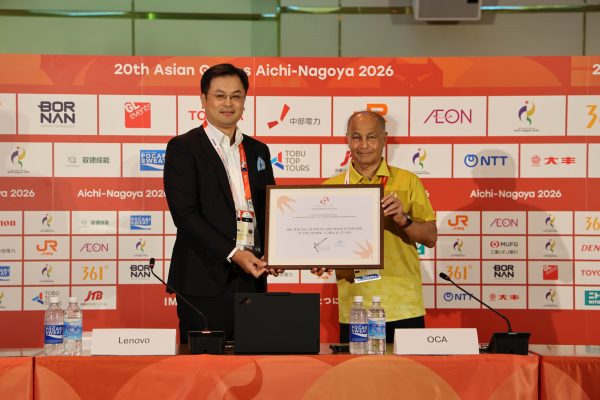
Lenovo and the Olympic Council of Asia (OCA) have signed a memorandum of understanding that will make Lenovo the OCA’s Official Solutions and Services Partner through 2030, establishing a long-term technology relationship covering sporting events across Asia.
The agreement was signed on September 20, 2026, in Nagoya, Japan, during the 20th Asian Games Aichi-Nagoya 2026. OCA Director General Captain Husain Al Musallam and Lenovo Executive Vice President and President of its Solutions and Services Group, Ken Wong, signed and exchanged the agreement at the Games’ Main Press Centre.
According to Lenovo’s official announcement, the partnership will focus on opportunities for artificial intelligence to improve sporting operations, support faster and more informed decision-making and create more connected experiences for fans across the region.
The OCA separately confirmed the signing in its official report, saying the ceremony marked the beginning of the new partnership between the two organizations.
The two organizations exchanged commemorative gifts after the signing. Lenovo presented the OCA with a specially designed ThinkPad displaying the partnership title, while the OCA presented Lenovo with a collection of Asian Games pins dating from 1951 to 2026.
Under the agreement, Lenovo and the OCA will examine how AI can be applied to the management of complex sporting operations, decision-making and fan experiences. A report published by UNI on September 20 also said the cooperation will examine AI applications involving athlete training, tactical analysis, coaching support and event management.
The announcement does not specify a new AI data centre, a particular server deployment, a dedicated OCA AI platform or a fixed infrastructure budget. The agreement is instead presented as a framework for exploring and developing technology applications over the partnership period.
Lenovo is bringing existing experience from major international sporting events into the relationship.
The company said it previously supported the Hangzhou Asian Games and the Harbin Asian Winter Games, where its technology was used to connect venues, support operations, provide information and equip media teams.
At the ninth Asian Winter Games in Harbin in February 2025, Lenovo was an official solutions and services provider for what organizers described as the first “Smart Asian Winter Games.” More than 1,500 athletes from 34 countries participated in the event, which was held across Harbin and the Yabuli ski resort.
Lenovo said more than 2,000 of its AI devices were deployed at the Winter Games, including ThinkPad laptops, ThinkCentre desktops and Legion gaming devices. The equipment supported data collection and transmission, interactive fan experiences and other technical requirements across the venues.
The company also deployed its Baiying AI Agent at the Games. Lenovo said the system, originally developed to simplify enterprise IT management through AI-powered consultations, was adapted to streamline IT services and support event operations.
According to Lenovo’s detailed account of the Harbin deployment, the AI systems and devices supported the stable operation of more than 20 IT systems across competition and non-competition facilities.
One of those applications was a commentary system running on Lenovo AI-powered PCs. The system collected and delivered real-time information while also providing commentators with historical information and current event updates.
AI was also used in the information distribution system to provide updates on event schedules, athlete profiles and medal standings, alongside live feeds covering arrivals and departures in competitor and spectator areas.
More than 100 Lenovo engineers and technical experts were stationed at the Harbin Games to maintain equipment ranging from slope-side data collection systems to broadcast transmission infrastructure.
The equipment underwent integration and coordination testing before the competition, while Lenovo used an integrated consulting, operations, maintenance and management service system during the Games.
The Harbin deployment also included sustainability measures. Lenovo said the Games used 56.76 million kWh of renewable electricity across venues and operations, while the company supported energy-reduction measures and managed IT equipment through its TruScale Device as a Service offering.
After the event, Lenovo said the equipment underwent data removal under privacy and security procedures before being recycled or repurposed.
The new OCA partnership also follows Lenovo’s involvement in the Hangzhou Asian Games. A 2023 ESG report from Legend Holdings, Lenovo’s parent company, said Lenovo provided full-stack intelligent products and services for Hangzhou, including AI-embedded smart terminals, AI-oriented infrastructure and AI-native solution services.
Lenovo’s wider sports technology portfolio includes AI, edge computing, servers, storage, high-performance computing, software-defined infrastructure, devices, software and services. The company describes this as part of its broader Hybrid AI strategy.
Lenovo also has a longer history in global sports. The company said it became a Worldwide Olympic Partner from 2004 to 2008 and supported the Torino 2006 and Beijing 2008 Olympic Games as an official computing equipment provider.
The OCA has also been examining AI in sports independently of the Lenovo agreement.
In February 2025, the organization held an AI Technology and E-Sports Seminar in Kuwait covering subjects including AI in traditional sports, AI and big data in athlete training, injury prevention, virtual and augmented reality, simulation, esports and wider sports digitization.
The new Lenovo partnership also sits alongside another major technology relationship involving Asian Olympic sport.
In November 2025, the Qatar Olympic Committee signed a memorandum of understanding with Microsoft covering digital transformation projects and the development of smart solutions and technologies for sport. The agreement included cooperation involving cloud computing and artificial intelligence applications.
The Lenovo agreement does not replace the OCA’s existing relationship with Bornan Sports Technology based on the information currently available.
The OCA announced in 2022 that Bornan would serve as its exclusive IT and Digital Partner for Asian Games and other OCA events. Its responsibilities include technology platforms for Games management, results management, the OCA channel, online stores and virtual television graphics.
The OCA reiterated the continuing nature of that relationship in June 2026, describing Bornan as its exclusive IT and Digital Partner for all series of Asian Games and other OCA events.

Discover more from Aree Blog
Subscribe now to keep reading and get access to the full archive.