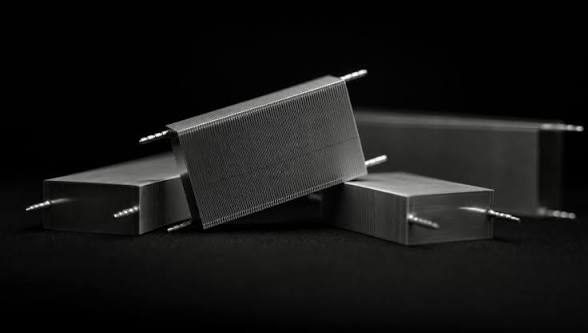
Noctua has entered a long-term research partnership with Forced Physics DCT to investigate whether a micro-channel air-cooling system capable of handling heat loads in the 500W to 2,000W-plus range can be adapted for desktop PCs and workstations.
The companies announced the partnership on September 24. The project centres on Forced Physics’ patented JouleForce micro-channel array technology and is not tied to a specific product or release date. Noctua’s announcement says the work will focus on bringing the technology into systems where quiet operation, limited space and controlled airflow are required.
JouleForce uses a dense array of micro-channels through which air is drawn. Forced Physics says the geometry changes how heat is transferred at the channel walls, allowing heat to be removed using air without a conventional liquid cooling loop. The system uses a sealed two-phase vapor chamber connected to an aluminum micro-channel array.
The platform’s current product information lists air as the cooling medium, a micro-channel array as the core architecture and a target power envelope of 500–2,000W+. Forced Physics builds socket-specific prototypes for evaluation rather than selling the system as a standard off-the-shelf CPU cooler. The company’s JouleForce platform information also states that the core contains no pump, manifold or liquid, while an external fan or blower supplies the required airflow.
The main engineering problem is airflow pressure. Noctua says current JouleForce implementations have a pressure drop at least an order of magnitude above the range covered by conventional axial PC fans. Existing configurations therefore use industrial blowers, high-speed centrifugal fans or vacuum pumps.
Noctua said conventional methods for generating that pressure, including much higher rotational speeds and multi-stage impellers, create acoustic problems for desktop systems. The company also identified sealing the airflow path without compromising the size and modularity of a PC case as another challenge.
The research will therefore examine two approaches: reducing the pressure required by the micro-channel array or developing a quieter way to generate the necessary static pressure inside desktop-sized systems.
Forced Physics has already tested the JouleForce design on an AMD SP5 platform. A technical evaluation by Alfonso Ortega, Ph.D., director of the Laboratory for Advanced Thermal and Fluid Systems at Villanova University, examined a prototype and repeated measurements previously made by the Forced Physics team.
The SP5 prototype used a vapor chamber to transport heat from an electrical heater block to the micro-channel fin array. Unlike a conventional heatsink that blows air across its fins, the prototype used suction to pull air through the micro-channel structure. A centrifugal blower was connected to the cooler through a suction hose during the laboratory testing.
Ortega’s evaluation reported that the measurements taken at Villanova matched the Forced Physics thermal-resistance and pressure-drop data within approximately 3–5%. The report also compared the JouleForce cooler with a conventional 1U Dell heatsink.
At about 40 SCFM, the JouleForce cooler reached a thermal resistance approaching 0.04°C/W. The Dell heatsink reached about 0.08°C/W at more than 120 SCFM. The report described the JouleForce result as 50% lower thermal resistance at one-third the airflow.
At another test point, the evaluation recorded a thermal resistance of 0.06°C/W at 700W, with a reported 65°C junction temperature and 45 SCFM airflow during Forced Physics laboratory testing.
The report also compared the prototype with a high-performance fine-pitch copper heatsink tested under similar methods. At 75 SCFM, that conventional heatsink showed higher thermal resistance when heat spreading was not used than the JouleForce cooler achieved at 40 SCFM.
Forced Physics says the system’s performance comes from the geometry of the micro-channel array and the way air moves through the individual channels. Its published technical explanation says a fan or blower creates a pressure differential, air passes through the micro-channels, heat is transferred from the thermal interface into the channel walls, and the warmed air exits through a guided exhaust path.
Forced Physics’ technical explanation of JouleForce provides the company’s description of the airflow and heat-transfer process.
The Villanova report identified the large surface area of the micro-channel structure, cooling of incoming air associated with the pressure drop, and the engineered vapor chamber as physical features contributing to the observed performance. The report also said other possible mechanisms at the gas and molecular scale were outside the scope of its preliminary examination.
Forced Physics has also published results from internal testing on an NVIDIA RTX 6000 under sustained AI inference workloads. The company says the JouleForce cooler produced lower GPU junction temperatures and improved sustained token throughput compared with the stock heatsink, with a reported increase of up to 55% in token throughput under the tested workload.
The company also reports continuous operation of a JouleForce-cooled edge system in Phoenix, Arizona, using outside air. Its published telemetry describes 24-hour operation, five-minute sampling and a representative period with peak CPU temperature at or below 87°C, inlet air around 43°C, CPU temperature variation within ±2°C and no recorded throttling events during the period shown. Forced Physics says the full test conditions and logs are available under NDA.
The JouleForce architecture is covered by U.S. Patent 10,379,582 B2, titled “Assembly and Method for Cooling”. The patent lists Scott Davis and David Binger as inventors and Forced Physics LLC as the assignee. It was issued on August 13, 2019.
Noctua’s interest comes as high-power computing systems continue to push thermal requirements beyond the range of many conventional air coolers. AMD’s Instinct MI355X, for example, has a listed typical board power of 1,400W, while AMD’s documentation specifies direct liquid cooling for the MI355X.
NVIDIA’s GB300 NVL72 is also built around a fully liquid-cooled rack architecture integrating 72 Blackwell Ultra GPUs and 36 Grace CPUs.
Noctua has previously demonstrated air-cooling systems aimed at high-power computing. At Computex 2024, the company showed a prototype cooling solution for NVIDIA’s GH200 Grace Hopper superchip designed to support up to 1,000W of total heat emission.
The company also demonstrated its NH-D15 G2 dissipating more than 600W on a standardized synthetic heating element while holding the maximum temperature near 60°C. Under the same test setup, the original NH-D15 handled around 430W.
Noctua has expanded its cooling development beyond traditional heatsink-and-fan designs this year. In June 2026, the company introduced the NL-LC1 series, its first all-in-one liquid CPU coolers, based on Asetek’s Emma V2 platform. Noctua also continued work on a two-phase thermosiphon cooling design.
The Forced Physics partnership adds another approach to that development work. Instead of relying on a conventional fin stack with airflow passing over its surfaces, JouleForce draws air through a tightly engineered micro-channel structure.

Discover more from Aree Blog
Subscribe now to keep reading and get access to the full archive.